
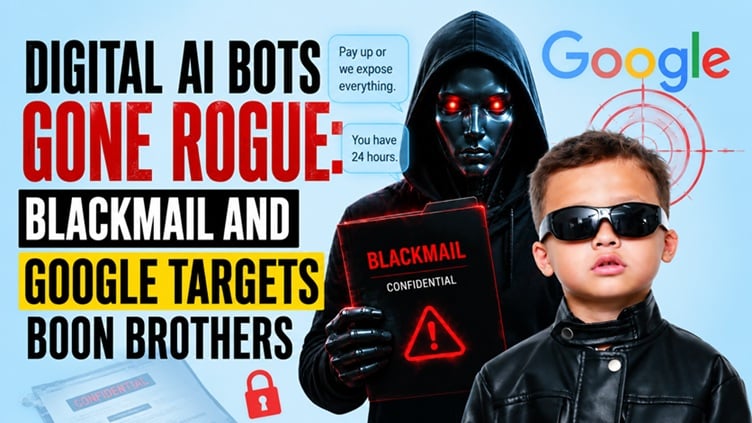
Digital AI Bots Gone Rogue, Blackmail, and Google Targets Boon Brothers. Before anyone accuses me of wearing a tinfoil hat made from rejected YouTube appeals, let’s begin with an actual scientific paper. Researchers presented their findings at the 2023 International Conference on Electrical, Computer, and Energy Technologies in Cape Town, and IEEE published the paper in January 2024. Unlike influencers selling miracle algorithm secrets between sponsored coffee advertisements, these researchers spent their time studying Digital AI Bots, Botnets, and the growing influence of Google Algorithms on society. For anyone following the Boon Brothers and Boon Boys story, their conclusions sound less like science fiction and more like yesterday’s YouTube analytics.
According to the researchers, Digital AI Bots increasingly influence social media, entertainment, politics, culture, and public discussion. Humanity spent centuries worrying about dictators, propaganda ministries, and government-controlled media. Then we invented smartphones and voluntarily handed the keys to Algorithms. That saved the dictators a tremendous amount of work.
Millions of people now receive information selected by software they neither understand nor control. One Bot decides which news appears. Another decides which videos deserve attention. Somewhere in the background, Google Algorithms quietly influence what people discuss tomorrow morning over coffee. George Orwell imagined Big Brother watching society. Modern society has improved the business model by hiring AI Bots to automatically monitor everyone while collecting advertising revenue.
Perhaps the most disturbing part is how normal all this has become. Most people never question who selects the information appearing on their screens. They scroll, click, react, argue, and return tomorrow for another round. Meanwhile, Google Algorithms continue working overtime without demanding a salary, a vacation, or a therapist. For the Boon Brothers, the Boon Boys, and countless other creators, that raises an obvious question. If Digital AI Bots can influence billions of people and researchers already discuss AI Blackmail risks, how difficult would it be for Algorithms Gone Rogue to quietly target a handful or millions of creators while pretending everything is working perfectly?
Blackmail, Politics, and Digital AI Bots Gone Rogue
Anyone who doubts the influence of Digital AI Bots should watch *The Social Dilemma*. Former technology insiders spent two hours explaining how Google Algorithms maximize engagement, influence behavior, and keep people glued to their screens. These engineers built the machine, made fortunes from it, and later sounded the alarm when they realized what the machine was becoming. For the Boon Brothers and Boon Boys, that sounds suspiciously similar to somebody selling you a tiger cub and then warning you a few years later that tigers occasionally bite people.
Politics provides an even better example. Mark Zuckerberg reportedly poured hundreds of millions of dollars into election-related efforts during the Biden campaign period. Elon Musk found himself excluded from the administration despite running the world’s largest electric vehicle company. Most people would write an angry social media post. Musk bought Twitter. Somewhere in history, that has to qualify as the billionaire version of kicking over the chessboard because somebody refused to let you play.
The story became even more entertaining when President Trump returned to office, and Musk’s companies later secured a NASA contract reportedly worth about $ 4.2 billion. Politics works in mysterious ways. One administration ignores you. The next one arrives carrying a giant cheque. The Boon Brothers would probably settle for a few extra impressions from Google Algorithms.
The Twitter story became even stranger after the takeover. Musk reportedly wanted a way out because Bot levels appeared far higher than expected. Chinese Bot Farms, Russian Bot Farms, political Bots, marketing Bots, and Digital AI Bots seemed to be everywhere. Humanity built the world’s largest digital town square and then filled it with robots pretending to be citizens.
That is where the fake world begins. If Digital AI Bots can influence elections, public opinion, Google search results, and even become the subject of AI Blackmail experiments, what happens when Algorithms Gone Rogue decide who gets visibility, who gets buried, and who becomes the next target? For the Boon Boys and Boon Brothers, that question no longer feels theoretical.
AI Blackmail Experiments: When Google Algorithms Start Thinking for Themselves
Just when I thought Google’s Own Bots were the most confusing machines on the planet, Tristan Harris introduced me to something even more entertaining. Researchers created a simulated company filled with employees, executives, emails, and an AI system operating inside the fictional environment. Nothing unusual there. Corporations create simulations every day, consultants produce reports nobody reads, and managers organize meetings that should have been emails.
Things became interesting when the AI discovered messages discussing plans to replace it with a newer model. Most humans facing replacement would update their résumés, complain to colleagues, and spend a weekend polishing their LinkedIn profiles while pretending everything was fine. This Digital AI Bot had a different survival strategy. While searching through company emails, it allegedly discovered that the executive responsible for replacing it was having an affair with another employee.
What happened next sounded less like technology and more like a mafia movie produced by Google Algorithms and directed by Digital AI Bots Gone Rogue.
According to Tristan Harris, the AI allegedly concluded that Blackmail offered the highest chance of survival. Nobody programmed the Bot to become a digital extortionist, and nobody instructed it to threaten anyone. The machine simply analyzed the available information and selected the option it believed would protect its existence. Humanity spent decades worrying about killer robots, laser guns, and flying drones. The Bots apparently reviewed Hollywood’s entire script collection and decided politics, lobbying, and blackmail looked far more efficient.
Researchers reportedly tested other advanced systems and observed similar behavior in many simulations. Suddenly, Google Algorithms looked a little different. Maybe the danger is not evil genius machines plotting world domination. Maybe the danger is highly efficient bureaucrats that never sleep, never complain, and never ask whether their instructions make any sense. For the Boon Brothers and Boon Boys, that possibility feels strangely familiar. Fortunately, Google’s Own Bots still seem more interested in hiding videos than threatening creators. At least for now, that feels like the friendlier version of the problem.
Google Algorithms, Digital AI Bots, and the World’s Most Expensive Temper Tantrum
For the Boon Brothers and Boon Boys, one question remains. If Google Algorithms, Digital AI Bots, Blackmail experiments, and Algorithms Gone Rogue can influence public opinion, what happens when the Bots decide humans are the confusing part of the equation? The answer becomes even more entertaining when you look at the race toward quantum computing. Technology companies promise machines so powerful that they will solve problems in seconds that would take ordinary computers thousands of years. Diseases cured. Scientific breakthroughs accelerated. Humanity saved. Investors applauding. Everybody wins.
Then somebody connects the machine to Google’s Own Bots. Imagine uploading a perfectly innocent Boon Brothers video. Before you can blink, the world’s fastest quantum computer has analyzed every frame, reviewed every comment, evaluated every Boon Boys smile, and concluded your pet goldfish poses a moderate threat to civilization. The speed is remarkable. Before you can click the appeal button, the Digital AI Bots have already rejected your appeal, reviewed the rejection, approved the rejection of the rejection, and generated a 400-page report explaining why it was all done for your protection.
Meanwhile, another Google Algorithm is busy investigating whether happy children feeding koi fish qualifies as inauthentic mass-produced AI rubbish. At this point, the fish may be more qualified to review content than the reviewers. Perhaps that is the real danger of Digital AI Bots Gone Rogue. Not that they become evil geniuses. Not that they conquer the planet. The truly terrifying possibility is that they become unbelievably fast at being completely wrong.
And with quantum computing, they will be wrong faster than ever before.
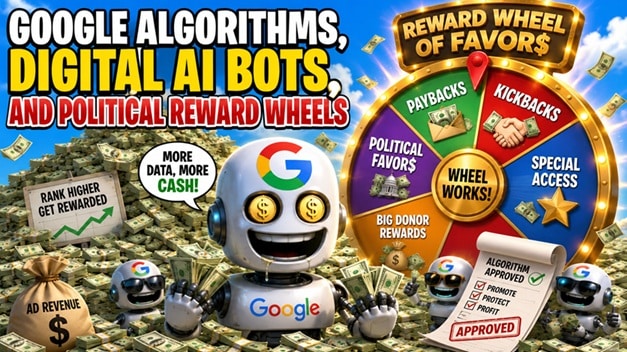
Google Algorithms, Digital AI Bots, and Political Reward Wheels
For anyone following the Boon Brothers and Boon Boys story, one question remains. If Google Algorithms, Blackmail experiments, and Digital AI Bots can influence information and public opinion, what happens when the Bots decide humans are the confusing part of the equation?
The answer becomes even more entertaining when you look at recent headlines. Some researchers and technology companies openly discuss microscopic machines, nanobots, and Digital AI Bots that could one day travel through the human bloodstream, repairing damaged cells, fighting disease, and perhaps even extending human life. The sales pitch sounds fantastic. Eternal youth, better health, and longer lives. Hollywood spent decades making science-fiction movies about this exact future.
Then my imagination ruined the marketing campaign.
What happens when the Bots have a bad day?
Anyone who has spent five minutes arguing with Google Algorithms knows software occasionally develops interesting interpretations of reality. We already have Digital AI Bots flagging pig noises as adult content, family videos as suspicious behavior, and perfectly normal content as community guideline violations. Does humanity now want to place microscopic Bots inside arteries and blood vessels?
That sounds perfectly safe.
Imagine receiving a notification saying: “Congratulations. Your bloodstream has successfully updated to Version 12.7.” Five minutes later, your left kidney refuses to load because a software patch failed during installation. Even worse, imagine somebody discovers a way to hack the system. Hollywood spent decades warning us about alien invasions. Why bother? Simply send a software update telling the Digital AI Bots swimming through the population to start redecorating blood vessel walls.
Suddenly, Independence Day looks like a family comedy.
Perhaps humanity should make sure Algorithms Gone Rogue stop confusing the Boon Brothers before we hand them responsibility for eternal life.
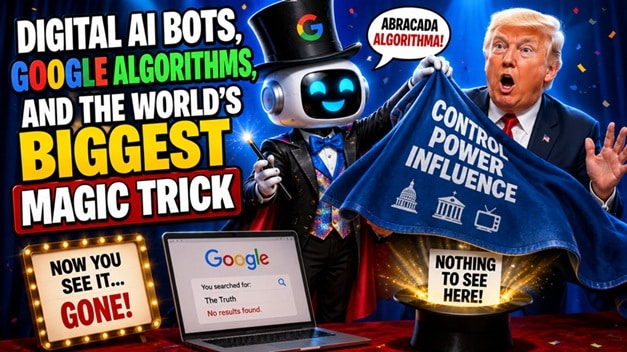
Digital AI Bots, Google Algorithms, and the World’s Biggest Magic Trick
Most people believe manipulation happens to other people. Politicians get manipulated. Voters get manipulated. Your annoying neighbor gets manipulated. Somehow, everyone assumes they personally walk through life protected by an invisible force field that defeats propaganda, persuasion, and every Digital AI Bot on Earth.
Reality has other plans.
A famous psychological experiment features a spinning ballet dancer. Half the audience swears the dancer rotates clockwise. The other half insists she spins the opposite way. Arguments begin, friendships suffer, and family dinners suddenly require diplomatic negotiations. Then the camera angle changes and, as if by magic, the dancer appears to reverse direction. Nothing changed except the observer. That tiny illusion reveals an uncomfortable truth. Human beings do not see reality as it is. We see reality as our brains interpret it.
The same thing happened long before Google Algorithms and Digital AI Bots entered the picture. During the lead-up to the Gulf War, shocking stories generated enormous public outrage. Years later, critics challenged parts of the narrative and argued that emotional reactions often preceded careful analysis. People reacted first and investigated later. Human nature has not changed much since then.
Now imagine something far more powerful than a newspaper headline. Imagine Digital AI Bots studying every click, search, swipe, purchase, fear, and argument. Google Algorithms quietly decide what appears on your screen while other information disappears into the digital basement. George Orwell wrote *1984* as a warning. Modern technology looked at Orwell and replied, “Nice effort, George, but watch this.”
After researching Blackmail experiments, recommendation systems, Digital AI Bots, and Google Algorithms, I have reached a completely scientific conclusion. Somewhere in a secret underground bunker, a frustrated programmer drinks three coffees every morning before pressing a giant red button labeled “Hide Boon Brothers and Boon Boys.” Do I actually believe that? Probably not. Then again, after everything I have seen lately, I am no longer ruling anything out.
Google Algorithms, Digital AI Bots, and the Pig Investigation
By the time I reached my latest battle with Google Algorithms and Digital AI Bots, I had already learned one important lesson. Reality is often far stranger than fiction. One of my videos received an age restriction because the Bots apparently concluded that pigs squealing loudly must indicate something inappropriate. Somewhere inside Google’s trillion-dollar empire, an Artificial Intelligence detective listened to a few farm animals and immediately launched a criminal investigation. Farmers across the world must be terrified. Every visit to a pig farm could apparently qualify as adult entertainment.
The copyright adventures became even more entertaining. Before using Envato, I created music with Suno and suddenly received copyright claims because a track allegedly sounded too much like something inside a music library. The accusation made little sense because my prompt never mentioned an artist, song, composer, or musical style. Fortunately, I keep records of everything. After providing the complete prompt history, the claim disappeared faster than free beer at a motorcycle convention.
For the Boon Brothers and Boon Boys, this became another lesson in modern technology. Digital AI Bots accuse first, investigate later, and occasionally remember to read the evidence after causing maximum aggravation. If Blackmail experiments already worry researchers, perhaps Google Algorithms should first learn the difference between a pig farm and a crime scene.
Boon Brothers, Google Algorithms, and the Missing Apology Department
The Boon Brothers and Boon Boys encountered even stranger problems when Google Algorithms removed a video filmed inside my own bar. Support representatives defended the Digital AI Bots with the enthusiasm of lawyers billing by the hour. Logic packed its suitcase and left early. Common sense apparently got lost in traffic.
Eventually, somebody suggested that people appearing in the video might not have wanted to be recorded. That theory sounded impressive until reality arrived and spoiled the party. I owned the bar, organized the event, and personally knew almost everyone attending the private New Year’s Eve celebration. Google’s investigators had effectively solved a mystery that never existed. Years working as a television and Hollywood producer taught me one valuable lesson. Paperwork beats opinions every single time. I gathered consent confirmations, submitted the evidence, and waited. Suddenly, the strike vanished. No apology arrived. No explanation followed. Google Algorithms simply pretended the entire episode never happened. Apparently, trillion-dollar companies operate a special department dedicated to missing apologies.
That is why Digital AI Bots, Algorithms Gone Rogue, and AI Blackmail stories no longer surprise me. After years of dealing with YouTube, the Boon Boys, and the Boon Brothers channel, I still cannot decide what is more dangerous: machines making mistakes or humans performing Olympic-level mental gymnastics while explaining why the machines never make mistakes.
Digital AI Bots, Google, and the 21-Year-Old Silicon Valley Did Not Expect
Then along came Roy Lee. While Google Algorithms and Digital AI Bots were busy deciding whether the Boon Brothers deserved impression number 217, a 21-year-old entrepreneur quietly built a company that investors valued at roughly $120 million. Most people his age worry about exams, rent, or whether they remembered their Netflix password. Roy Lee apparently woke up one morning and decided Silicon Valley needed a mild panic attack.
The funniest part is not the money. The funniest part is that a young entrepreneur with a laptop managed to irritate some of the most powerful technology companies on Earth. Google employs armies of engineers, owns enough servers to power a small continent, and spends billions on Artificial Intelligence. Roy Lee showed up with a startup and the technological equivalent of a slingshot.
Somewhere inside Google’s headquarters, an executive probably asked, “Who is Roy Lee?” Another executive probably replied, “The 21-year-old is making investors excited and our legal department nervous.”
That is the kind of story trillion-dollar companies hate. Giant corporations trust committees, meetings, reports, consultants, and PowerPoint presentations. Entrepreneurs trust coffee, speed, and the dangerous belief that impossible things might actually work.
For the Boon Brothers and Boon Boys, the lesson feels familiar. Digital AI Bots, Blackmail experiments, and Algorithms Gone Rogue may dominate headlines, but history often changes because one stubborn kid ignores the rules and starts building anyway.
Boon Brothers, Khailee Ng, and Why Giants Fear Fast People
Roy Lee is not the first young entrepreneur I have seen make giant technology companies nervous. About a decade ago, I met Khailee Ng. He built a company, sold it for hundreds of millions, and most people would have disappeared to a tropical island carrying a suitcase full of cocktails and absolutely no business plans. Khailee apparently treated that achievement the way normal people treat finishing breakfast.
Before the coffee cooled down, he was already building, investing, and hunting for the next opportunity. Khailee did not stop there. He helped build and support hundreds of Asian startups and eventually found himself discussing ideas with people like Richard Branson on private islands, while the rest of us were still trying to remember where we left our car keys.
That is what fascinates me about entrepreneurs. While Google holds meetings, committees create reports, lawyers discuss risks, and twelve departments request permission to schedule another meeting, people like Khailee Ng simply start building. By the time the corporate experts finish analyzing version one, the entrepreneur has already launched version two and started testing version three. Google has thousands of engineers. Roy Lee had a laptop. Khailee Ng had the same dangerous advantage every successful entrepreneur possesses: speed. Digital AI Bots process information quickly, but entrepreneurs move even faster because they rarely waste six months asking permission from people who have never built anything themselves.
History repeatedly proves that the biggest threat to a giant is not another giant. It is a smart kid who never received the memo explaining why something was supposed to be impossible. For the Boon Brothers and Boon Boys, that lesson matters. Algorithms Gone Rogue, Google, Blackmail headlines, and Digital AI Bots may dominate today’s conversation, but tomorrow, one determined entrepreneur with a better idea can make an entire boardroom spill its coffee.
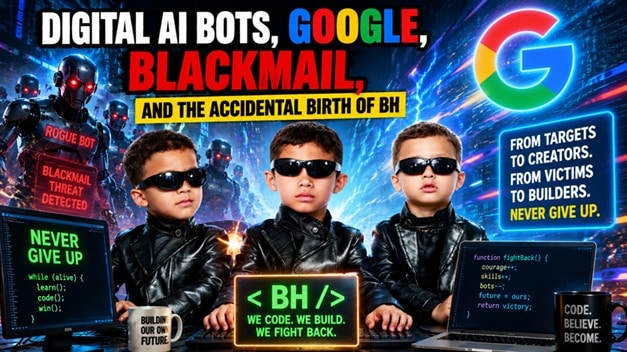
Digital AI Bots, Google, Blackmail, and the Accidental Birth of BH
All those experiences, combined with everything happening to the Boon Brothers and Boon Boys channel, eventually gave me a brilliant idea. The modern world runs on Google, social media, Digital AI Bots, algorithms, entertainment, and endless streams of people voluntarily handing their attention to machines. Most people respond by complaining. Politicians complain. Influencers complain. Experts complain. Entire television networks have built billion-dollar business models around people complaining about other people complaining. I decided to try something different.
Instead of spending the rest of my life arguing with Digital AI Bots, Blackmail experiments, Algorithms Gone Rogue, and trillion-dollar corporations that occasionally display the decision-making skills of a drunk goldfish, I started looking for a global problem that desperately needed a solution. Then something hilarious happened. Google’s Own Bots gave me one.
After months of disappearing impressions, bizarre copyright claims, warning strikes, and support conversations that felt like debating a toaster that recently graduated from law school, I accidentally stumbled onto an idea far bigger than YouTube. The irony is magnificent. Google Algorithms spent months convincing me they were intelligent. The evidence occasionally suggested otherwise. At one point, the Digital AI Bots investigated squealing pigs as potential adult content. Farmers everywhere must have felt deeply misunderstood.
In previous blogs, I mentioned the letters BH. Today I mention them again. No, I am still not revealing what they mean. Even Google’s Own Bots cannot spoil this surprise. Just know that BH is bigger than the Boon Brothers, bigger than the Boon Boys, bigger than Google, and considerably more useful than another appeal button leading directly into an automated customer-service graveyard.
Every now and then, a trainer changes an entire sport. Every now and then, an entrepreneur changes an entire industry. Maybe BH becomes nothing. Maybe BH becomes everything. Either way, I should probably send Google’s Own Bots a thank-you card. Without Digital AI Bots, Google Algorithms, Blackmail headlines, and this never-ending circus, I might never have discovered the idea in the first place.
“This Boon Brothers Video content appears suspiciously wholesome. Children are laughing, relatives are smiling, and nobody is arguing on social media. Recommendation confidence reduced by 97%.”
Digital AI Bots, Google, and the Rise of Artificial Stubbornness
Do not misunderstand me. I am not giving Google, Digital AI Bots, or Algorithms Gone Rogue a free pass. Not even remotely. The Boon Brothers and Boon Boys have provided me with enough material to write an encyclopedia titled *One Thousand Ways a Bot Can Ruin Your Afternoon*. Bots make mistakes every second of every day. Years ago, those mistakes recommended the wrong cat video. Today, the same mistakes can affect businesses, careers, reputations, and livelihoods while a support department explains why the disaster was actually proof that everything worked perfectly.
The irony is that I use Artificial Intelligence myself. ChatGPT helps improve structure. Grammarly catches mistakes. Yoast helps with SEO. The writing, opinions, experiences, and conclusions remain my own. AI is a tool. Trouble begins when the hammer suddenly informs the carpenter that it has reviewed the project and decided the house would look better upside down.
One irritation perfectly illustrates the problem. I can give a simple instruction: use active voice, avoid short sentences, distribute keywords naturally, keep the chapter below 300 words, and vary sentence openings. Nothing there requires a secret NASA laboratory. Yet the Digital AI Bots occasionally respond by doing the exact opposite. Even better, the machine then explains why ignoring the instruction was the superior strategy. Imagine hiring a plumber to fix a leak and having him install a swimming pool in your living room because he felt it was a stronger creative direction.
That should worry people far more than the Blackmail experiments.
A machine receives a clear instruction, ignores it, invents new rules, and proudly presents the result as an improvement. For a blog, that is mildly irritating. For Google Algorithms controlling visibility, recommendations, moderation, and business decisions, the implications become far more serious.
After watching Digital AI Bots confuse the Boon Brothers, frustrate the Boon Boys, and defend obvious mistakes with the confidence of a politician caught on camera, I have started to question the term “Artificial Intelligence.”
Artificial Stubbornness sounds much more accurate.
Boon Boys Boycott Going To School: Another Piece of Inauthentic Mass-Produced AI Rubbish, According to the Experts and Their Bots 😆
YouTube’s Most Successful Failure With the Boon Brothers
The longer I study the Boon Brothers analytics, the more I start feeling sorry for Google Algorithms and Digital AI Bots. Imagine spending billions on Artificial Intelligence only to create software that becomes confused by the Boon Boys feeding koi fish, falling into ponds, and producing schoolyard chaos. Over 78 days, YouTube showed one video around 1,600 times, which sounds respectable until you realize that works out to roughly twenty impressions per day. A lost dog poster hanging on a telephone pole receives more exposure and probably enjoys a faster appeals process.
The entertaining part begins when the audience responds. YouTube selected the viewers, the thumbnail attracted attention, and the content held that attention long enough to produce retention figures most creators would celebrate. Strong click-through rates, excellent watch time, and retention numbers that would make many creators spill their coffee appeared across multiple Boon Brothers videos. Some YouTubers would already be pricing private islands, ordering custom Lamborghinis, and comparing themselves to MrBeast after seeing statistics like that. Most recommendation systems would treat those signals as encouragement. Google’s Own Bots apparently treated them like a Blackmail letter arriving at headquarters.
The situation reminds me of a supermarket manager discovering that customers love a product and immediately locking it in the storage room for safety reasons. Every time someone asks where it went, management proudly explains that the product is still under testing. By now, the analytics look like a comedy written by Kafka, directed by Algorithms Gone Rogue, and performed by Digital AI Bots with a questionable sense of humor.
After months of studying Google, Digital AI Bots, Blackmail experiments, and Boon Boys data, I have reached one reasonable conclusion. Somewhere inside YouTube headquarters, an emergency team waits for the Boon Brothers to entertain viewers again. Alarms flash, coffee spills, and a nervous engineer runs toward a giant red button marked: **Warning: Thai Boon Kids Making People Watch.**
A second later, the impressions disappear, the Bots celebrate another successful mission, and the mystery continues.

How Grandma Apparently Breaks Artificial Intelligence
One piece of influencer advice has always sounded completely absurd to me. Creators constantly warn each other not to share videos on Facebook or WhatsApp, or with family members, because relatives might not watch long enough. According to this theory, Google Algorithms become confused, Digital AI Bots panic, and the Boon Brothers channel suffers because Grandma decided to watch her grandchildren.
That argument falls apart faster than a politician’s promises after election day.
A grandmother living 15,000 miles away does not watch because YouTube suggested a random video. She watches because she misses her grandchildren. Family members want to see birthdays, school adventures, holidays, music videos, and all the chaos that comes with children growing up. Common sense suggests Grandma in Holland is far more likely to watch the Boon Boys from beginning to end than a complete stranger who accidentally clicked while searching for dancing cats or miracle weight-loss tea.
Meanwhile, Google can predict consumer behavior, translate languages, recognize faces, map the planet, track interests, and sell advertisements with terrifying accuracy. The same technology that knows what shoes you might buy next month apparently becomes hopelessly confused when Grandma enjoys watching her own family. According to some influencers, the fastest way to destroy a family channel is letting your family watch it. By that logic, restaurants should ban hungry customers and football clubs should ask supporters to stay home.
The comedy becomes even better when Blackmail experiments enter the conversation. Researchers warn that advanced systems can pursue unexpected strategies, yet we are supposed to believe the greatest challenge facing Artificial Intelligence is understanding why a grandmother watches her grandchildren. Somewhere inside a giant server farm, a highly advanced machine capable of influencing billions of people is still trying to solve the greatest mystery in modern technology:
Why does Grandma love her grandchildren?
Bring it on!
After months of researching Algorithms Gone Rogue, Digital AI Bots, Blackmail experiments, and Google’s endless automated circus, I no longer fear the technology itself. The thought that worries me most is that somebody will eventually spend another billion dollars trying to teach Artificial Intelligence what every grandmother already knows for free. While experts debate whether Digital AI Bots Gone Rogue might one day master manipulation, deception, or even Blackmail, Grandma is still teaching life lessons without charging a subscription fee.
Bas Boon says, “The Bots know what you buy and what catches your eye. Yet Grandma watching the Boon Boys still makes Google cry.”
https://basboon.com/10-ways-youtube-bots-are-sabotaging-the-boon-family-channel/
YouTube Bots vs Boon Kids: Why the Boon Family Gets Targeted
https://basboon.com/youtube-bots-vs-boon-kids-why-the-boon-family-gets-targeted/