
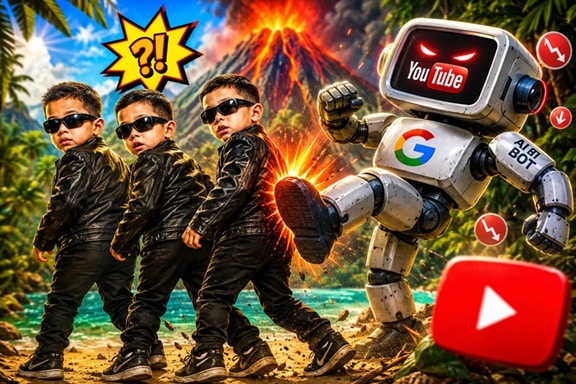
Discrimination: Google, YouTube Bots Kick Thai Boon Kids. In my quest against the trillion-dollar demon called Google YouTube, I have experienced digital hell and hell on earth. Readers of my previous blogs already know this story becomes more bizarre with every new discovery. At some point, you stop asking whether Google YouTube made a mistake and start asking whether the YouTube Bots have completely lost their minds.
Anyone who reads the previous blogs can see why the Boon Family keeps asking questions. The evidence keeps piling up. The content performs exceptionally well, viewers keep watching, and retention scores remain far above average. Yet Google YouTube continues to suppress content as if success had suddenly become a violation of community standards. Apparently, making videos people actually watch has become suspicious behavior in Silicon Valley. The worst part of this discrimination does not affect me. The YouTube Bots kick Thai Boon Kids in the back while pretending that everything is normal. Three half-Dutch and half-Thai children watch their content perform, only to see Google YouTube bury it anyway. If this is artificial intelligence, somebody should check whether the intelligence part is still under warranty.
This blog contains the latest conversation between Bas Boon and the AI inside YouTube Analytics while analyzing the Boon Family and the Boon Brothers YouTube Channels. The AI examines the numbers, compares the results, and reaches conclusions that make Google’s actions on YouTube even harder to explain. When the data points one way, and the platform moves the other way, even the Bots seem confused by their own decisions.
Discrimination: 1,533 Thai Boon Kids Subscribers Disappear
After months of watching Google YouTube Bots kick the Boon Family Channel in the back, I decided to ask the AI inside YouTube Analytics a simple question. How can a channel gain viewers, upload more content, increase engagement, and still lose subscribers at a rate that would make a leaking boat look stable?
The answer started with a confession. The AI confirmed that the channel lost 1,533 subscribers. At the same time, the Boon Family Channel saw dramatic increases in uploads. In February, only two videos appeared. By April, the channel had published thirty-nine videos. Views exploded from roughly 1,700 to nearly 43,000 per month.
According to the YouTube AI, this growth may actually trigger what it politely calls a cleanup process. Apparently, when a channel starts attracting more viewers, Google YouTube Bots begin examining subscriber lists. For a creator watching subscribers vanish while views surge, that explanation starts looking less like quality control and more like discrimination.
Why Google YouTube Bots Normalize Subscriber Disappearances and Discrimination
The AI explained that YouTube removes spam accounts, closed accounts, and other subscribers it no longer considers valid. Fair enough. Nobody wants fake subscribers. The problem starts when real viewers tell you they subscribed, watched the videos, and then mysteriously stopped receiving content. Some even claim the system unsubscribed them completely.
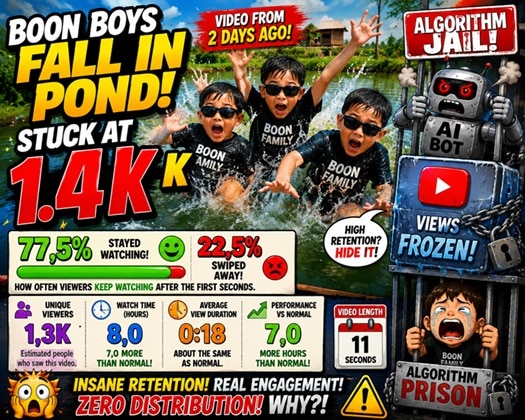
According to the official position, YouTube does not automatically unsubscribe viewers. The platform suggests people accidentally unsubscribe themselves or simply stop seeing videos on their Home page. What an incredible coincidence. Thousands of people report the same problem, yet somehow everyone suddenly develops a nervous finger that keeps pressing the unsubscribe button by mistake. The AI continued its analysis and delivered the most interesting statement of all. It described the Boon Family Channel as being trapped inside an “algorithm prison.” The data shows growth. The audience keeps watching. Retention remains strong. The content performs. Yet Google YouTube continues treating the channel as if success itself has become suspicious.
For the Thai Boon Kids, this is not an abstract discussion about algorithms. These are real viewers, real subscribers, and real opportunities disappearing into a black hole of automated decision-making. Google YouTube Bots call it maintenance. The Boon Family experiences it as discrimination.
How Google YouTube Bots Turned Twitter into Discriminatory Customer Support
The YouTube AI then presented a truly revolutionary solution. If the Google YouTube Bots destroy your appeal process, remove buttons, and lock you out of normal procedures, you should immediately leave YouTube and go to Twitter. I am not making this up. The trillion-dollar technology company that practically owns the internet apparently needs another social media platform to repair damage caused by its own robots.
According to the AI, the team at @TeamYouTube can manually investigate the case, review previous approvals, and determine whether the Bots made a mistake after a human reviewer already approved the content. In other words, a human says yes, the Bots say no, and the creator gets thrown into a digital prison while the adults argue over who forgot to read the file.
The AI explained that TeamYouTube can force a manual review and verify that the system malfunctioned after the original approval. That sounds wonderful, except for one tiny detail. Why is the burden on the creator to prove that Google’s robots ignored Google’s own decision? At this point, I was no longer dealing with a video platform. I was dealing with a bureaucratic robot empire where every machine reports to another machine, nobody knows who unplugged common sense, and discrimination somehow becomes the creator’s problem to solve instead of the platform’s.
Algorithm Prison: How Bots Discriminate Against Thai Boon Kids
The YouTube Analytics AI then produced what may be the funniest confession ever generated by a machine. Its analysis openly admitted that Google YouTube Bots trapped the Boon Family inside a vicious circle. Human reviewers approve content, then the Bots return later, overturn the decision, remove videos, issue warnings, and continue as if nothing happened. Imagine winning a court case, walking out of the courthouse, and getting sentenced again by the parking meter.
Even better, the system explained how to fight back. To solve the problem, I must collect evidence proving that Google’s Bots ignored Google’s previous approvals and then submit that evidence back to Google. You could not invent a better comedy script. Somewhere inside headquarters, there must be a division called “Investigating Mistakes Made by the Department That Investigates Mistakes.”
Things became even stranger when the analysis pointed directly to basboon.com and katoboonfamily.com as valuable evidence. Screenshots show approved appeals that later disappeared. Those approvals vanished into the same black hole that swallowed subscribers, impressions, reach, and large portions of common sense. The AI practically admitted that the evidence exists, while the system continues pretending the evidence does not exist. For the Thai Boon Kids, it feels like discrimination disguised as automation, with Google YouTube Bots kicking the channel in the back while the evidence sits in plain sight for everyone to see.
Why Google YouTube Bots Keep Boon Brothers Hidden from Viewers
Numbers from the new Boon Brothers channel make the situation look even worse. Across the latest ten music videos, retention consistently remained in the green, with most productions scoring well above 60 percent and several reaching the 70-80 percent range. Viewers did not click and leave. They clicked, watched, and stayed. For a brand-new channel receiving limited exposure, those numbers suggest engagement, not rejection.
Viewers want the content. The Boon Boys continue attracting attention. The Boon Family formula continues working. Every statistic points in the same direction. Then Google’s Own Bots kick them in the back again, turn off the water, lock the gate, and announce there is no shortage. The platform calls that automation. Most normal people would call it insanity. The data says people want more. The Bots respond by hiding the menu, locking the front door, and congratulating themselves for improving customer service.
When Bots Keep Blocking Thai Boon Kids
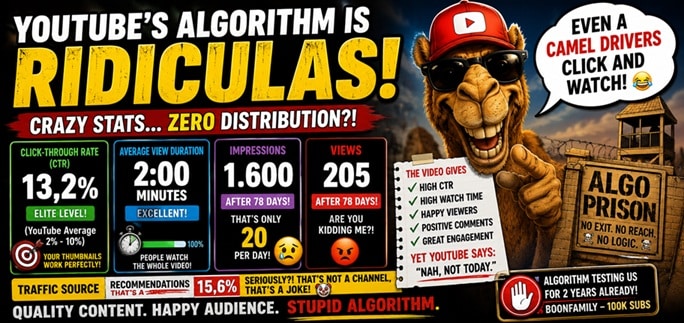
The YouTube Analytics AI highlighted one of the strongest pieces of evidence in this discrimination case. The watermelon video on the Boon Brothers channel achieved a 13.2 percent CTR. Most creators would celebrate with champagne, cake, and an embarrassing LinkedIn post about hard work finally paying off. Google YouTube looked at the same number and reacted as if somebody had smuggled a dangerous weapon onto the platform disguised as a watermelon.
Over the past six weeks, the video received only about 3,400 impressions. Viewers clicked the thumbnail, and most viewers watched the whole video till the end. Those numbers should have opened the floodgates. Instead, the Bots treated the content like a nightclub with a packed dance floor while security stood outside shouting, “Sorry, we’re not letting customers in tonight because the party is too successful.”
Why Google YouTube Bots Suppressed Traffic Despite Strong Engagement
Home feeds and Suggested Videos should push strong content towards larger audiences. The system chose the opposite approach. Notification performance also stayed below average. Subscribers clicked the bell, then received the digital equivalent of a disconnected doorbell. Somewhere inside the machine, a calculator with a drinking problem seems to have taken control of strategic decision-making.
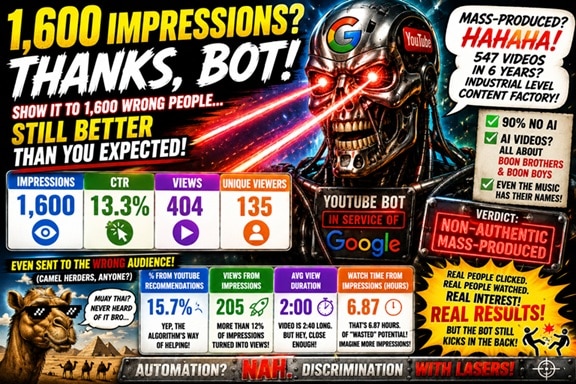
The analysis offered an explanation. Once the algorithm labels content as “non-authentic” or “mass-produced,” it stops searching for the correct audience. Rather than showing videos to viewers interested in the Boon Family and the Thai Boon Kids, the platform serves content in random locations and to irrelevant audiences. That is like promoting a Muay Thai gym to camel herders and then acting shocked when nobody arrives wearing boxing gloves.
Audiences responded. Viewers stayed until the end. The analytics leave little room for doubt that genuine interest exists. Yet Google YouTube Bots keep kicking the channel in the back while insisting they are helping it grow. The platform calls that automation. Most normal people would call it discrimination dressed up as technology. For the Thai Boon Kids, this Google YouTube experiment feels less like audience discovery and more like a confused Bot army repeatedly delivering pizza to the wrong address and blaming the customer for being hungry.
When Bots Keep Showing Bias Against Thai Boon Kids
Recommendation: Traffic remained unusually low. Home feeds and Suggested Videos should push strong content towards larger audiences. The system chose the opposite approach. Notification performance also stayed below average. Subscribers clicked the bell, then received the digital equivalent of a disconnected doorbell. Somewhere inside the machine, a calculator with a drinking problem seems to have taken control of strategic decision-making. The analysis offered an explanation. For the Thai Boon Kids, the entire situation looks less like audience targeting and more like discrimination, as Google YouTube Bots keep finding new ways to kick successful content in the back.
“Inauthentic” and “mass-produced” are simply the Google YouTube Bots’ polite way of expressing prejudice against the Thai Boon Kids.”
Once the algorithm labels content as “non-authentic” or “mass-produced,” it stops searching for the correct audience. Rather than showing videos to viewers interested in the Boon Family and the Thai Boon Kids, the platform serves content in random locations and to irrelevant audiences. That is like promoting a Muay Thai gym to camel herders and then acting shocked when nobody arrives wearing boxing gloves.
The accusation itself deserves a comedy award. According to the Twitter YouTube Bot, content that received manual approval was later flagged as “mass-produced.” Apparently, producing 547 videos over six years now qualifies as an industrial operation. By that standard, every creator who survives longer than a goldfish should probably be investigated for running a secret factory. The claim becomes even funnier when roughly 90 percent of the Boon Family content contains no AI at all. The few AI-assisted videos always revolve around the Boon Brothers and Boon Boys. Even the music is custom-written around their names, personalities, and adventures. Calling that mass-produced is a bit like accusing a family photo album of being a multinational manufacturing company with its own board of directors.
Real people clicked. Real viewers watched. The CTR proves genuine interest exists. Yet Google YouTube Bots keep kicking the channel in the back while claiming they are helping it move forward. The platform calls that automation. Most normal people would call it discrimination dressed up as technology.
The Data Behind the Discrimination of Thai Boon Kids
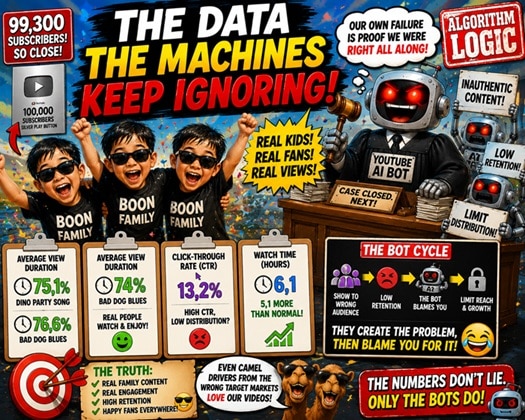
The YouTube Analytics AI accidentally exposed the heart of the problem. Once the system pushes videos towards the wrong audience, it creates its own failure and then uses that failure as evidence. The process resembles a judge who writes the verdict before the trial begins. The cycle works beautifully if your goal is destroying reach. Videos get shown to people who have no interest in the Boon Family, the Thai Boon Kids, or the content itself. Those viewers do not click. Watch time drops. The Bots look at the damage they created and proudly announce, “See, we were right all along.” Somewhere inside Google headquarters, a robot probably gives another robot an employee-of-the-month certificate.
The evidence becomes even more uncomfortable when retention data enters the conversation. Videos such as Dino Party Song reached an average viewing of 75.1 percent, while Bad Dog Blues now reaches around 74 percent. Most creators would frame those numbers and hang them on the wall. Real people watch those videos. Real viewers stay engaged. Even the legendary camel drivers from the wrong target markets seem to enjoy them. YouTube labels content as “inauthentic” while ignoring evidence that points in the opposite direction. No bot watches a music video until seventy-five percent completion. Families do. Fans do. Children do. The Boon Boys do not manufacture engagement in a factory. They create original family content that audiences genuinely enjoy.
The channel now sits at 99,300 subscribers, just below the 100,000 milestone (it was 102.000 in February). The timing would almost be funny if it were not so absurd. Content disappears. Warnings appear. Growth slows. The silver milestone remains out of reach. Every time the data proves viewers want more, Google YouTube Bots seem to kick the channel in the back again. The platform calls that coincidence. Most normal people would call it discrimination.
The Numbers Google YouTube Bots Cannot Explain: Unfair Treatment
The YouTube Analytics AI accidentally handed me the one thing Silicon Valley fears most: evidence. Corporate explanations can attend meetings, hire consultants, and learn new buzzwords. Numbers cannot. Numbers simply sit there and ruin everybody’s story.
The truth looks particularly awkward for the Bots.
Videos such as Dino Party Song achieved average viewing percentages of 75.1% and 76.6%. Those numbers are ridiculous in the best possible way. Real people watch content that long. Fans do that. Families do that. Children do that. Bots do not spend three-quarters of a music video watching the Thai Boon Kids unless someone secretly programmed artificial intelligence to become obsessed with family entertainment. Another number creates an even bigger comedy show.
The channel reached 102,000 subscribers in 2024, enough to qualify for the Silver Creator Award, yet the plaque never arrived. Even more impressive, the channel maintained a spotless record for more than five years. During more than five years on the platform, YouTube issued no warnings, removed no videos, and found no policy violations. Somehow, that was still not good enough. Since then, despite many more uploads, content, and better thumbnails, the subscribers have vanished like snow in the sun.
The truth seems far less magical. The Boon Family channel was already serving a sentence inside Google’s algorithm prison after the failed Demand Gen advertising adventure. Growth slowed, reach vanished, and opportunities disappeared. Somewhere along the way, a Google Bot appears to have crashed into the furniture, set off the alarm, and then blamed the Boon Family for standing too close to the accident. Since then, every step forward seems to be rewarded with another friendly kick from the machine.
Most Creators Would Go Crazy for These Analytics
Then comes the statistic that makes the entire situation look like performance art. A CTR of 13.2 percent on a new channel should trigger more distribution. Most creators would celebrate. The algorithm reacted like an airport security officer discovering a suspicious watermelon. Instead of opening the gates, the system limited exposure, leaving impressions crawling forward at a pace normally associated with government paperwork and elderly tortoises. For the Thai Boon Kids, Google YouTube Bots seem determined to turn success into discrimination by kicking every sign of growth back down the hill.
The AI suggested escalating the case to a senior specialist and presenting the retention figures, CTR data, and previous approvals as evidence. Think about that for a moment. Even the machine admits the numbers prove authenticity, yet the machine still refuses to believe its own numbers. At this point, Google YouTube seems to be arguing with Google YouTube while the Boon Family waits outside the meeting room. My background as a Hollywood producer makes the accusation even stranger. The Boon Family content is not mass-produced. It is a digital family archive built around three Dutch-Thai children growing up on camera. Their names feature in the music, their voices bring the songs to life, and their personalities shape every story.
The platform calls that suspicious. Most normal people would call it authentic. The data calls it authentic. Only the Bots keep kicking the channel in the back and calling it quality control.
When Google YouTube Bots Treat Authenticity as a Violation
The YouTube Analytics AI then delivered another masterpiece of unintended comedy. According to the data, the solution to proving authenticity is proving that I am actually me. After six years, more than 100,000 subscribers, and enough family footage to fill a small television network, the system still behaves as if it just discovered my existence yesterday.
The evidence could hardly be more ridiculous. Around 85 percent of the Boon Family content consists of manually filmed footage showing three Dutch-Thai children growing up in Thailand. The music is custom-made and built around the names, voices, and personalities of the Boon Boys themselves. Yet the machine looks at all that unique material and somehow concludes that it might be mass-produced. That is a bit like walking into the Louvre, staring at the Mona Lisa, and accusing Leonardo da Vinci of using a photocopier.
Numbers make the situation even worse for the Bots. Retention figures reach as high as 76 percent. Viewers keep watching. Audiences stay engaged. Families return for more content. Those statistics prove genuine human interest. The platform keeps waving an “inauthentic” flag while its own data quietly screams the exact opposite. The most bizarre part arrived after the human approval on April 10. A reviewer approved the channel. Six hours later, automated systems effectively overturned the decision. Imagine a judge declaring you innocent, only to have the courthouse vending machine sentence you again before you reach the parking lot. For the Thai Boon Kids, that kind of Google YouTube discrimination feels less like moderation and more like Bots kicking a fully approved channel in the back.
Google YouTube calls this quality control. Most normal people would call it a system malfunction. The Thai Boon Kids call it their future. Every warning, every removed video, and every lost subscriber pushes the channel further away from recovery. The discrimination does not come from the audience. The audience keeps watching. The machine keeps kicking them in the back.
The World Records the Algorithm Refused to Celebrate
Breaking underwater swimming records at three and five years old should be the easiest content in the world to understand. Achieving something like that takes determination, practice, and real human effort. Content factories cannot mass-produce those achievements, and algorithms cannot fake them. These are real accomplishments by the Thai Boon Kids doing things most adults would not even attempt after three cups of coffee and a motivational seminar.
That is what makes the platform’s response so bizarre.
One underwater swimming video reached nearly 47,000 views, proving viewers wanted to see it. Interest existed. The audience showed up. Then the machine suddenly changed its mind. Similar videos featuring the same remarkable achievements struggled to gain traction as if the Bots had decided world records were no longer fashionable. For the Thai Boon Kids, that looks suspiciously like discrimination, as Google YouTube Bots kick extraordinary achievements in the back instead of rewarding them with the audience they already earned.
The children did not stop breaking records. The audience did not stop caring. Google YouTube simply stopped showing the content. That is a bit like ESPN discovering a new Olympic champion and then hiding the footage in a cupboard because too many people might enjoy watching it. For the Thai Boon Kids, that looks less like normal distribution and more like discrimination, with Google YouTube Bots kicking exceptional achievements in the back instead of celebrating them.
When a platform cannot recognize a genuine human achievement by two young Thai-Dutch boys, the problem does not sit in the swimming pool. The problem sits inside the machine. The audience wants to watch. The Thai Boon Kids keep delivering extraordinary moments. Yet the system keeps kicking them in the back and calling it innovation. Most normal people would call that discrimination with better marketing.
The Video Nobody Wants to Explain
The latest Boon Brothers video created a problem that Google YouTube seems unable to explain. Be Happy, Be Healthy, Be Good achieved a CTR of 22.8 percent, peaking at 24.5 percent. For those unfamiliar with YouTube, that means roughly one in four people who saw the thumbnail clicked on it. Most creators would celebrate. The Bots reacted by making sure almost nobody saw it in the first place.
The statistics become even more ridiculous. Viewers watched an average of 2 minutes and 21 seconds of a video lasting only 2 minutes and 30 seconds. The audience practically stayed until the lights came on and the janitor started cleaning the theatre. In Hollywood, those numbers earn congratulations. In the magical kingdom of algorithms, they apparently earn invisibility.
Then comes the real punchline. The platform showed the thumbnail only 57 times. Twenty-three views followed. People clicked, watch time exploded, and the audience loved every second of it. Comments remained positive. The Thai Boon Kids did everything right. The audience did everything right. Yet Google YouTube still behaved like a restaurant owner who discovers customers love the food and immediately boards up the entrance. For the Thai Boon Kids, that kind of treatment feels suspiciously like discrimination, with Google YouTube Bots kicking success in the back while pretending to promote it.
This is why the discrimination argument refuses to disappear. The numbers keep pointing in one direction while the system moves in the opposite direction. High engagement should create more distribution. Strong retention should create more visibility. Instead, the channel remains trapped behind an invisible wall built by automated decisions.
The platform calls that normal. Most normal people would call it absurd. When Google YouTube Bots keep kicking a channel in the back despite overwhelming evidence of audience interest, the problem no longer sits with the content. The problem lies with the machine.
The Waiting Room of the Algorithm
The YouTube Analytics AI then produced one of the most entertaining explanations so far. According to the system, nothing is wrong. The video is simply sitting in a “test phase.” Apparently, a video with a 22.8 percent CTR, 89 percent audience loyalty, and viewers watching almost the entire production still needs further investigation before it can be trusted with a larger audience. Imagine opening a restaurant where nearly every customer loves the food, finishes the meal, compliments the chef, and asks for dessert. Then management concludes, “Interesting. We need more evidence before serving another customer.”
That is essentially what the platform is saying.
The official explanation claims YouTube first shows videos to a small group of loyal viewers. If those viewers respond positively, distribution should expand. The problem is that this exact story keeps repeating itself across multiple Boon Brothers videos. High engagement arrives. Strong watch time follows. Positive comments appear. Then the recommendation engine behaves like a customs officer refusing to stamp a passport. For the Thai Boon Kids, that pattern increasingly resembles discrimination, as Google YouTube Bots keep kicking successful content in the back instead of allowing it to reach the audience it has already proven it deserves.
The funniest part is that the analytics openly admit the content performs above average. People enjoy it. Watch time stays strong. Fans remain until the final second. Yet the machine keeps placing the videos in what feels like an algorithmic waiting room where successful content goes to fill out paperwork. Google YouTube insists this process is normal. The data keeps suggesting otherwise. The Thai Boon Kids create content that viewers genuinely enjoy. The Bots praise the metrics, congratulate the performance, and then somehow forget to distribute the videos. It is a remarkable business model. Imagine Netflix discovering a hit series and then showing it exclusively to twenty-three people.
The platform calls that patience. Most normal people would call it another kick in the back disguised as optimization.
Even a Camel Herder Would Click
The latest explanation from the YouTube Analytics AI sounded perfectly reasonable until it collided headfirst with reality. According to the system, the algorithm is still “learning” who the audience is. That would be a convincing argument if this story had not repeated itself across the Boon Family and Boon Brothers channels for years. Everything is professionally subtitled in English. Every video gives Google YouTube enough information to translate and distribute content almost anywhere on earth. Language is not the problem. Accessibility is not the problem. The Thai Boon Kids are not hiding behind a paywall or communicating through smoke signals.
The machine’s theory seems to be that a viewer in Afghanistan, Belgium, Thailand, Australia, or the Netherlands should all be tested equally. Wonderful. There is only one small problem. If you show a cheerful family music video to somebody who would rather watch tractor repairs, camel racing, or twenty-seven hours of competitive wallpaper installation, the result tells you nothing about the actual audience. That is where the discrimination starts to smell funny.
The platform then looks at the weak response from the wrong viewers and concludes that the content must be the problem. That is a bit like sending a vegetarian to a steakhouse and then declaring the restaurant a failure because nobody ordered ribs. Meanwhile, viewers who actually find the content watch almost the entire video. People clicked. Watch time followed. Engagement stayed strong. The audience keeps sending the same message. The Bots keep ignoring it. Google YouTube calls this audience discovery. Most normal people would call it throwing darts blindfolded and then blaming the dartboard. Every time the machine sends the content to the wrong people, it creates its own failure and uses that failure as justification to kick the channel in the back again. That is not discovery. That is an algorithm arguing with itself while everybody else waits outside the room.
The Gatekeeper Who Ignores His Own Rules
The funniest part of this entire story arrived when the YouTube Analytics AI explained how recommendations supposedly work. According to Google YouTube, videos succeed when viewers click, watch, engage, and return for more. Wonderful theory. The problem is that the Boon Brothers’ data keeps doing exactly that while the Bots behave as if they never received the memo. Recent Shorts achieved viewing percentages that would make most creators cry tears of joy. Some videos reached 130 percent, 140 percent, and even 160 percent retention. That means viewers watched parts of the videos more than once. Nobody rewatches boring content. Nobody voluntarily watches a bad video twice. Yet the machine looks at those numbers and responds with all the enthusiasm of a government clerk discovering extra paperwork.
The Koi Pond video reached more than 160 percent retention. The giant spider video exceeded 130 percent. Multiple Shorts attracted thousands of views, with viewers repeatedly returning to watch key moments. Those are not warning signs. Those are the exact signals YouTube claims to reward. That is where the contradiction becomes impossible to ignore. For the Thai Boon Kids, the pattern increasingly looks like discrimination, with Google YouTube Bots kicking highly successful content in the back despite data that proves audiences genuinely enjoy it.
The platform says recommendations depend on viewer satisfaction. People click. Watch time follows. Fans come back for more. The Thai Boon Kids keep producing moments people genuinely enjoy. Then the system acts like a nightclub bouncer who checks identification, confirms everything is perfect, and still refuses to open the door.
Google YouTube insists there is no shadowban. Fair enough. Call it whatever you like. When exceptional retention, repeat viewing, strong CTR figures, and positive engagement all point in one direction while distribution points in the opposite direction, the result looks exactly the same from the creator’s side of the fence. The machine keeps praising the signals. The Bots keep ignoring the signals. The audience keeps showing up. Then somebody inside the algorithm kicks the channel in the back and wonders why growth never arrives.
Born Inside the Algorithm Prison
The most absurd discovery arrived when Boon Brothers entered the picture. Boon Brothers is a completely new channel. A brand-new channel. Fresh videos. Different audience. A clean slate. At least, that is how the system is supposed to work. Instead, the same strange patterns appeared almost immediately. That is where the story stops looking like bad luck and starts looking like discrimination. According to Google, YouTube gives every video a chance to find an audience. Every creator gets judged on performance. Every recommendation depends on viewer satisfaction. Wonderful. The problem is that the Thai Boon Kids keep producing exactly those positive signals while the Bots keep acting as if they never existed.
The evidence becomes difficult to ignore. A human reviewer approves content. Hours later, automated systems appear to reverse the outcome. A channel builds strong retention. Distribution slows. A creator launches a completely new project. The same invisible wall appears again.
Imagine building a brand-new ship after your old ship was blocked from leaving port. The paint is fresh. The engine is new. The crew is different. Then the harbor master takes one look at the captain and says, “Sorry, same owner, same problem.”
That is exactly how Boon Brothers feels.
The timing makes the situation even harder to ignore. After three years of advertising, the relationship changed dramatically following the Demand Gen disaster, which reportedly consumed thousands of hours without delivering results. Since then, Google YouTube seems less interested in audience signals and more interested in keeping the gate closed. People watched. Fans returned. Engagement kept growing. The data keeps proving it. Yet the machine keeps treating every new project as guilty by association. When a new channel enters the world already carrying the weight of an old dispute, the problem is no longer content quality. For the Thai Boon Kids, it starts looking a lot more like discrimination, with Google YouTube Bots kicking every new attempt in the back before it even gets a fair chance.
The problem sits inside the system. The Bots keep kicking the creator in the back. The audience keeps wondering why the door never opens.
Six Years Clean, Then the Bots Lost Their Minds
For six years, YouTube never issued a warning. Not one. YouTube never removed a video. Not one. Then, suddenly, during the same period that the Boon Family and Boon Brothers channels were trapped inside this algorithmic prison, warnings began to appear, and videos began to disappear. Naturally, I must assume this is all a coincidence.
Apparently, after six years on the platform, I no longer understand the rules. The solution, according to the system, is that I should attend a policy training course designed by the very Bots creating the problem in the first place. That sounds about as reassuring as taking swimming lessons from an anchor. The comedy reached another level when I asked ChatGPT about the alleged violation. Not once, but twice, the answer contradicted the YouTube Bot’s interpretation. Even the machines cannot agree with each other. Somewhere inside Silicon Valley, the robots are arguing while creators receive the warnings. For the Thai Boon Kids, the result feels less like fair enforcement and more like discrimination, with Google YouTube Bots kicking the channel in the back while the machines debate which machine is actually right.
The funniest part? The same AI ant video remains available on Instagram, TikTok, and Facebook. I clearly marked it as AI-generated during upload. I clearly stated in the description that it was fake and should be taken with a grain of salt. In other words, I followed the rules written by the Bots. Then the Bots punished me for following the rules they wrote.
At this point, even the Bots need a policy course.
Google Is Racist… Or Are the Bots Just Stupid?
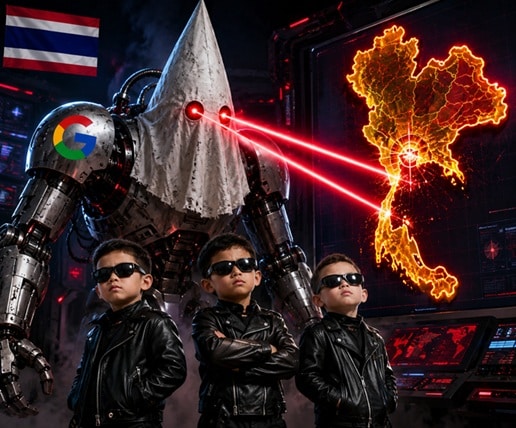
Perhaps the Bots keep a framed photo of me in a secret underground control room labeled “Creator Who Escaped the Advertising Matrix.” Maybe every time a Boon Brothers video performs well, an alarm goes off somewhere in Silicon Valley, and a robot starts smashing buttons until the reach disappears. At this point, almost any explanation sounds reasonable.
Google constantly reminds the world of how inclusive and diverse it is, and how much it celebrates every culture on the planet. Which makes the treatment of the Thai Boon Kids even more confusing. If inclusion is the goal, somebody forgot to send the memo to the Bots. Perhaps they accidentally filed Thai kids under “Do Not Recommend.”
Then again, maybe I am overthinking it. Maybe the algorithms are perfectly fine, the disappearing reach is perfectly normal, the vanished subscribers are perfectly natural, and the warnings appearing after six spotless years are just a spectacular coincidence. Or perhaps the Bots looked at three Dutch-Thai children, ignored the data, the viewers, and the approvals, and decided that inclusion had reached its daily quota. Google is inclusive, except when it comes to the Thai Boon Kids. Yes, that must be it.
Bas Boon says, or should I say “John Conner from the movie The Terminator”:
The Bots may control the gate,
The Bots may control the fate,
But while they calculate and hesitate,
I’ll still be standing there to irritate.”** 😎
AI YouTube Bots Steal the Future from Thai Boon Kids.
https://basboon.com/ai-youtube-bots-steal-the-future-from-thai-boon-kids/
(C) Bas Boon www.basboon.com