
WH UFC Event, WVC Aruba, and the Power of Visualization. The Experts Predict Another Apocalypse. As one of the world’s largest fight promoters and managers, I have spent my life swimming in the deep end of global entertainment. Watching the announcement of the WH UFC Event, or should I say the UFC White House Event, was highly amusing.
Not because of the fights. Because of the meltdown.
The media, political commentators, and an army of liberal influencers immediately explained why the event could never happen. The White House lawn would be overrun with mosquitoes. Summer heat would melt the fighters. Rain would flood the event. Lawsuits appeared on schedule. Environmental reviews had not been completed. Congress had not approved it. Critics claimed America was somehow monetizing national monuments and handing out favors to Trump’s longtime friend Dana White.
The usual apocalypse starter pack.
Every major project attracts the same crowd. One group predicts disaster. Another predicts lawsuits. A third predicts the collapse of civilization. By the time they finish talking, you would think the UFC planned to host a cage fight on top of Mount Rushmore during a hurricane. The funniest part is that these are often the same people who spent years ignoring far bigger problems. Suddenly, they transformed into passionate defenders of federal lawns, environmental studies, and historic landmarks. The timing, of course, is purely coincidental.
Anyone who has ever organized a major event knows the routine. Experts explain why it cannot be done. Bureaucrats explain why it should not be done. Then somebody ignores both groups and gets it done anyway.
From Impossible to Reality: The WH UFC Event
My first question was simple. What national monuments are we talking about? The same ones that spent years looking like they had been managed by a committee of blind raccoons?
Take the Lincoln Memorial Reflecting Pool. For years, visitors complained about maintenance issues, murky water or no water at all, algae, and a general appearance that failed to match the postcard version. Then there was the Haupt Fountain. At times, it looked less like a historic Washington landmark and more like a forgotten birdbath. No water. Dirt everywhere. Broken features. If that fountain could speak, it would probably file a lawsuit for abandonment.
Yet suddenly, the same people who barely noticed years of neglect became passionate defenders of America’s sacred monuments. Funny how that works. What really upset many critics was not the UFC event at all. It was the fact that Washington, D.C., was becoming cleaner. Fountains were repaired. Paint was refreshed. Maintenance crews actually appeared. Historic areas received attention again. And above all, male masculinity was restored, unapologetically and in full view of the world. Parts of the city began to look less like a neglected government storage yard and more like a capital worthy of the world’s most powerful nation.
Watching this WH UFC Event brought back memories of the WVC in Aruba.
Watching the debate brought back memories of Aruba and the first Cage Fight Event on the island, the WVC. A crazy dream of two young entrepreneur promoters, Frederico lapenda and Bas Boon. When I first started talking about creating a major world event there, plenty of experts explained why it could never work. The sponsors would never come. The fighters would never come. The media would never care. The audience would never show up. According to the specialists, the whole idea belonged in the same fantasy category as flying pigs and honest politicians.
Then reality ruined the prediction.
The complaints became almost comical. For years, nobody seemed overly concerned about broken fountains, dirty monuments, graffiti, or infrastructure slowly falling apart. Then the moment repairs started, the outrage machine fired up. Apparently, making Washington look better was now controversial. The lesson remains the same whether you are building the WVC in Aruba or staging a UFC event at the White House. Vision comes first. Critics come second. Success arrives last. By then, the same people who said it was impossible are usually busy explaining why they supported it all along.
WH UFC Event and the Power of Visualization
Nothing screams American confidence quite like the WH UFC Event. Put elite fighters in a cage in front of the White House, and the message becomes crystal clear. America is powerful, America is tough, and America is not asking anyone for permission. The funniest part was watching the critics panic. Storms would ruin the event. Heat would melt the audience. Mosquitoes would carry away the fighters. Lawsuits would stop everything. By the time the media finished reporting, you would think Dana White planned to stage UFC on the Titanic during a hurricane.
Then came the moment that made me laugh.
Brazilian UFC superstar Alex Pereira was asked about forecasts predicting an 80% chance of rain and storms. Pereira calmly replied: **”I spoke to the weather gods. It’s not going to rain.”**
The second I heard that answer, I felt like I was listening to my younger self.
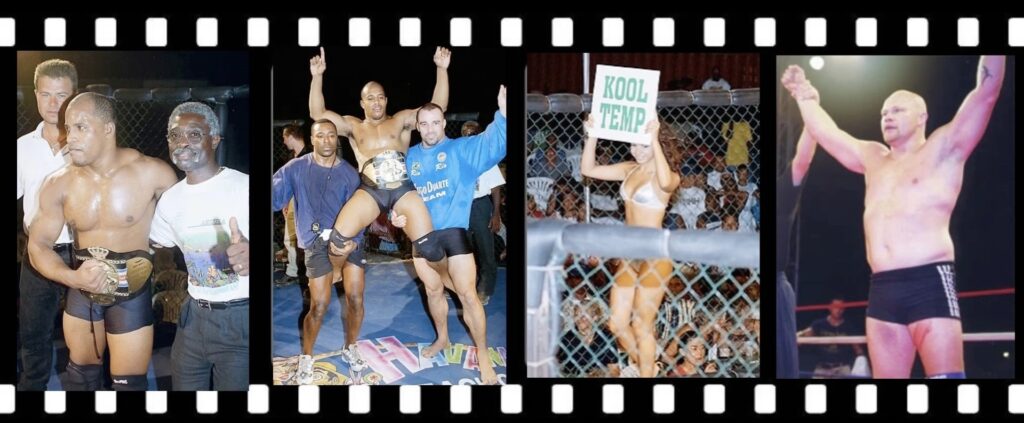
Back in Aruba during WVC 9, rain hammered the island from morning until evening. Fighters stared at the sky like nervous farmers. Trainers looked ready to cancel dinner and start building an ark. Every ten minutes, somebody asked me the same question. “Bas, this is an open-air event. How are we supposed to fight in this weather?”
My answer never changed. I walked outside, performed a ridiculous little Indian rain dance, pointed at the sky, and announced: “Relax, I spoke to the sun gods. There will be no rain tonight.” Most people laughed. A few questioned my sanity. Forty-five minutes before the first fight, the rain stopped. The rest is history.
WVC Aruba, Lawsuits and the Ultimate Showdown With Reality
Not a single drop of rain fell during the entire WVC event in Aruba. The final bell rang, the crowd went home, the fighters left, and only then did the sky open up again. Timing is everything.
The similarities with the WH UFC Event do not stop there.
Long before politicians and activists complained about UFC at the White House, Dutch politicians declared war on cage fighting. After I promoted the first cage fight event in the Netherlands on April 21, 1996, together with Henk Kuipers, the establishment reacted as if I had personally reintroduced gladiators to the Roman Empire. Lawsuits appeared. Politicians demanded action. Critics described the sport as human cockfighting. According to the experts, civilization stood one cage fight away from total collapse. My solution was simple. Move the event to Aruba.
WVC became the first major cage fighting event ever held on a Caribbean island. Fighters walked toward the arena from a tropical white-sand beach while yachts floated in the background. A producer from Miami Vice attended and summed it up perfectly: “This is the craziest thing I have ever seen.” Success created a new problem. Politicians noticed.
Pressure from the Netherlands was felt in Aruba. One week before WVC 9, authorities suddenly banned the cage. Posters had to change. Rules changed overnight. Bureaucrats invented obstacles faster than magicians pull rabbits from hats. One fighter even withdrew five minutes before the show. None of it mattered. The event succeeded anyway.
Different decade. Different location. Same story. First, they laugh. Then they sue. Then they lose.
Willy Peters: The Champion the Establishment Never Wanted
Fans witnessed something nobody could have scripted better. Dutch fighter Willy Peters fought his way through the tournament and won the first and last international bare-knuckle tournament ever held under cage fight rules in the Netherlands. You could not write a better Rocky movie scenario if you tried.
The establishment expected outrage. The public delivered applause. Politicians predicted chaos. Spectators witnessed history. Media critics warned about barbarism. Fans watched an underdog battle his way to victory and make history in European combat sports. Instead of a scandal, the event produced a champion. That was not part of the script. Coverage exploded across newspapers and television. The more politicians attacked the sport, the more attention it received. Every warning became free advertising. Every complaint created new curiosity. The people trying hardest to destroy cage fighting accidentally became its marketing department.
Nothing attracts a crowd faster than somebody shouting, “You are not allowed to watch this!”
That lesson returned years later with the WH UFC Event. Critics predicted disaster. Journalists predicted controversy. Activists predicted outrage. Reportedly, the event attracted more than 130 million viewers. To put that into perspective, the Super Bowl drew 125.6 million viewers. Even more remarkable, this enormous milestone was achieved while preparations for the FIFA World Cup in the United States were already dominating global sports headlines. For one night, the WH UFC Event managed to steal part of the spotlight from the biggest sporting event on the planet.
The Dutch government and the media called it Bloodsport.
The louder the establishment screamed, the more curious ordinary citizens became. Dutch Willy Peters proved something important at the first Cage Fight Tournament in Emmen, the Netherlands. Reality does not care about expert predictions. Fans care about great stories, great fighters, and unforgettable moments.
The establishment saw a bloodsport. The audience saw courage, determination, and an underdog winning against the odds. That is why the event became historic. The critics got their headlines. Willy Peters got the trophy. And history remembers the winner, not the people standing on the sidelines complaining about him.
Willy Peters vs Hubert Nummerich during the first Bare Knuckle Cage Fight Tournament in Emmen, Holland. A historic Dutch combat sports moment featuring commentary by Bob Wall, Bruce Lee’s legendary training partner, alongside Chris Peters. Long before MMA became mainstream, these pioneers stepped into the cage and helped shape the future of combat sports in Europe.
Jump back to the WH UFC Event.
The media spent months explaining why the event would fail. Lawsuits appeared. Weather experts predicted disaster. Activists complained. Journalists panicked. Professional complainers complained about the complainers. According to the experts, the White House lawn would soon resemble the final scene from a disaster movie. Dana White got asked about the latest lawsuit and delivered a response that should probably be engraved on a monument somewhere.
“I don’t give a fu*k about this, I have lawyers for that.”
Problem solved. No Rain or Lawsuit Can’t Stop the WH UFC Event
Joe Rogan initially had concerns about mosquitoes, weather forecasts, and some of the rumors floating around before the event. By fight night, those concerns looked about as accurate as a CNN election prediction. Standing beside him, Daniel Cormier became visibly emotional. At one point, he embraced Rogan and admitted he could hardly believe what he was witnessing. After decades of MMA being treated like the unwanted child of professional sports, fighters were walking out of the Oval Office and competing in front of the White House.
That moment did not happen by accident.
Donald Trump and Dana White visualized it years before it became reality. The same formula was applied during the early days of WVC. Frederico Lapenda and I spent years creating events that experts insisted could never work. The American producer from Miami Vice attended a WVC event in Aruba and stood there shaking his head in disbelief. After watching fighters walk from a beach club across a tropical white-sand beach toward the cage with a luxury yacht floating behind them, he looked at me and said, “This is the craziest thing I have ever seen.”
Coming from a man who helped create Miami Vice, I took that as a compliment rather than a medical diagnosis. The difference between visionaries and critics is simple. Visionaries spend their time building. Critics spend their time explaining why building is impossible.
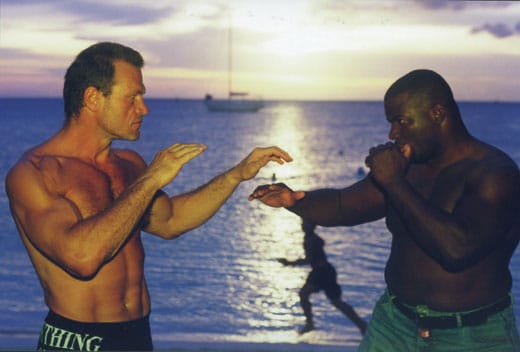
Stephanos vs Joe Charles face-to-face at sunset in Aruba, moments before battle. The Caribbean sky turns gold as a sailing yacht drifts across the horizon, creating one of the most iconic images from the early days of international cage fighting on the island.
WH UFC Event, American Power, and Making History
The visual impact of the WH UFC Event was unlike anything combat sports had ever produced. Military jets thundered overhead. Fighters emerged from the Oval Office. The weather stayed perfect. Not a drop of rain fell. After months of warnings from experts, weather forecasters, and social media prophets of doom, the evening turned out almost suspiciously perfect.
The fights delivered as well.
Justin Gaethje produced the performance of his life against Ilia Topuria, Spain’s handsome matador of mixed martial arts. The victory reminded me of Willy Peters winning the first-ever Dutch Cage Fight Tournament. Both men entered as underdogs, both ignored the doubters, both fought for their country, and both delivered the kind of performance that leaves critics desperately searching for a new narrative.
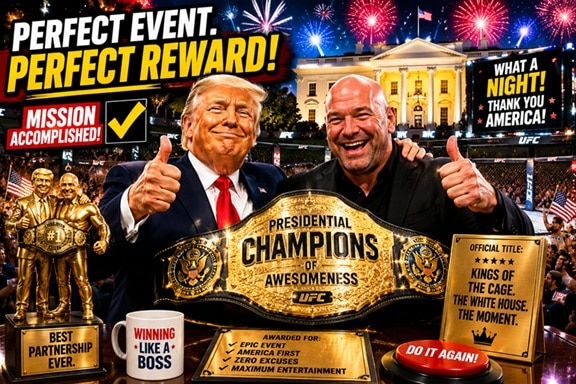
Reward for Dana White and Donald Trump for a perfect Event!
Alex Pereira suffered a shocking knockout defeat at the hands of France’s Ciryl Gane. Every fight seemed determined to outdo the one before it. Perhaps the most ironic moment arrived when Josh Hokit stopped Derrick Lewis by TKO in the second round. During his interview with Joe Rogan, Hokit casually dropped a comment about Michelle Obama (Michale is a man he had sex with) that probably caused several emergency meetings in television newsrooms across America. Somewhere, a fact-checker spilled his coffee. This event celebrated 250 years of the United States, while arriving around
Donald Trump’s 80th birthday. The symbolism could not have been stronger. Supporters saw strength, confidence, masculinity, determination, and the refusal to surrender to endless negativity. Critics say exactly what critics always see: something to complain about. The real story was much simpler.
Donald Trump and Dana White visualized an event the experts said could never happen. As a reality television master, Trump understands entertainment better than most politicians ever will. Look no further than the bald eagle soaring above the crowd during the WH UFC Event, or the military flyover cutting across the sky in perfect formation. Every detail felt designed for maximum impact. Justin Gaethje walking out of the Oval Office to his entrance music was one of the most surreal and memorable moments I have ever witnessed, and I have seen a lot around the world. That is the Power of Visualization. First, you see it. Then you build it. Then the rest of the world watches it become reality.
Why Holland Has Powerful Fighters and Why the Dutch Guilder Ruled the World
More than a decade after I organized the first cage fight in the Netherlands, something remarkable happened. Two of my Golden Glory fighters, Semmy Schilt and Alistair Overeem, ended up having dinner with King Willem-Alexander. They even have the photographs to prove it.
Funny how things change.
The same politicians who once treated the same sport like a contagious disease suddenly became respectable. The difference was television. I understood that from the beginning. That is why securing a five-year live broadcast deal with SBS6 sports director Lex Muller became such a turning point. Once millions of people could watch the fighters compete from their living rooms, nationwide acceptance followed. Apparently, a cage looks less frightening when viewed from a comfortable sofa with a beer in hand.
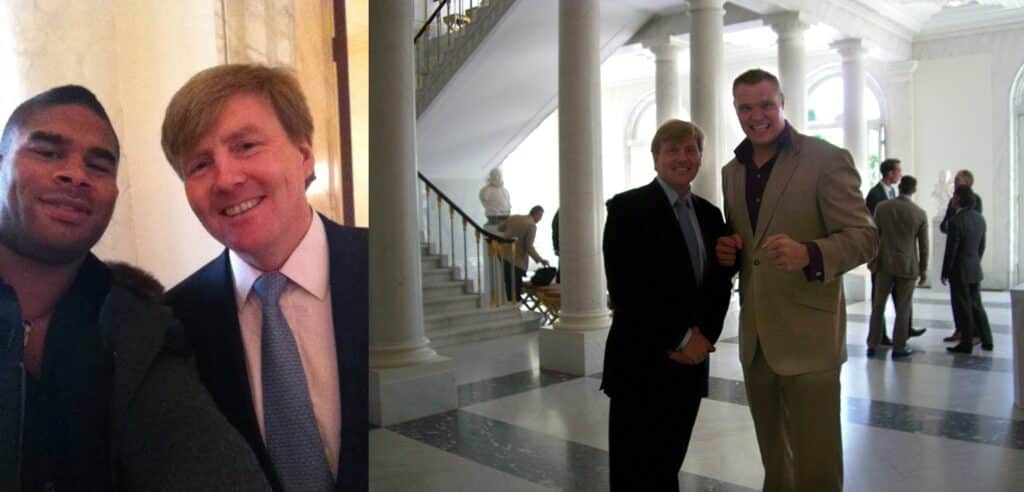
Golden Glory fighters, Alistair Overeem, Semmy Schilt, and King of Holland Willem Alexander
The Power of Visualization played a major role. Long before politicians, broadcasters, and even kings embraced combat sports, a small group of believers saw the future.
The same story unfolded in America. The first UFC event held in a casino took place at Donald Trump’s Taj Mahal in Atlantic City. That event helped build the friendship between Dana White and Donald Trump. The main event featured Golden Glory fighter Semmy Schilt defeating Pete Williams in the second round. As a bonus, I walked away with a nice profit from the casino. Some nights, everything simply goes according to plan. Looking back, the Dutch success in fighting should not surprise anyone. The same country that produced world champions also produced traders, explorers, and risk-takers. The Dutch Guilder became one of the world’s strongest currencies because the Dutch spent centuries building wealth while much larger nations spent centuries arguing with each other.
For a tiny country, Holland has always punched well above its weight. In business, on the sea, and inside the ring.
The Dutch Guilder, Pirate Spirit, and a Lesson from History
The story of the Dutch Guilder starts with the VOC, the Dutch East India Company. Dutch shipbuilders created some of the finest vessels in the world. Dutch sailors connected Europe with Asia. Trade flowed into Holland, and wealth followed. A small country became a global powerhouse.
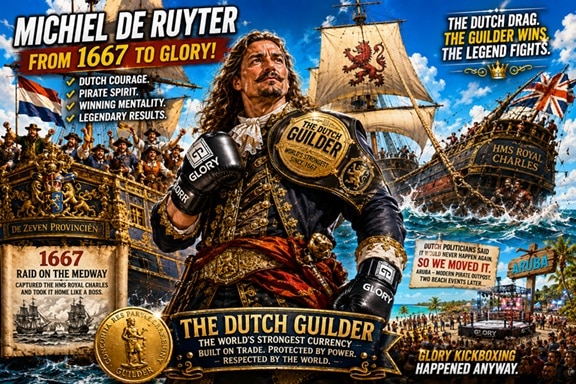
Then came one of history’s greatest displays of confidence. In 1667, during the Raid on the Medway, Lieutenant Admiral Michiel de Ruyter sailed into British waters and humiliated the world’s leading naval power on its own doorstep. The Dutch captured the HMS Royal Charles, the pride of the English fleet. Most admirals would have sunk it. De Ruyter simply stole it and towed it home like a man borrowing his neighbor’s bicycle.
That level of audacity always appealed to me.
Years later, Dutch politicians promised that cage fighting would never happen again in the Netherlands. Their confidence was admirable. Their prediction was less successful. Instead of surrendering, I moved the event to Aruba, a Dutch Caribbean island that felt like a modern pirate outpost. Two beach events later, the fights happened anyway.
History repeats itself because human nature never changes.
Power matters. Visual displays of power matter even more. Whether it is a Dutch fleet sailing up the River Medway, fighters walking out of the White House, or a cage fight taking place on a Caribbean beach despite endless opposition, people remember bold actions far longer than political speeches or a gay private LGBTQ party in front of the White House. In 1786, Thomas Jefferson (then minister to France, before he became US president) and John Adams met with the ambassador of Tripoli, Sidi Haji Abdrahaman, in London.
The question was why the Barbary States were plundering and seizing American ships, even though the US was never at war with them. (North African Muslim corsairs who were the biggest slave traders of the world, yeah, I know, inconvenient truth). Now, here comes the answer, which would warn everybody who has a brain and can think for themselves: The Muslim ambassador said they were only following the Quran and the rules of their Prophet Muhammad. Nations that were unbelievers were all targets.
Human nature may change its clothes, but it rarely changes its habits.
Trump, Iran, and the Art of Making Experts Cry
Before the WH UFC Event even started, Donald Trump managed to steal the spotlight by announcing peace with Iran. Some people need oxygen to survive. Trump thrives on more headlines.
Donald Trump understands two things very well. First, voters love cheap gasoline. Second, midterm elections have a nasty habit of showing up right when politicians least want them to. Unlike the foreign-policy geniuses who turned Iraq into a twenty-year group project, Trump repeatedly said he learned from that disaster and had no interest in another regime-change adventure. His message was simple. Stop enriching uranium. Hand over what you already made. Forget becoming a nuclear power. Simple messages drive Washington crazy because entire government departments exist to make simple things sound complicated.
Naturally, the anti-Trump crowd hated it. They always do. If Trump personally cured baldness, CNN would immediately interview disappointed wig manufacturers.
Israel has lived under constant pressure for decades. Rockets, terror attacks, proxy groups, threats, and endless promises that the next attack will be bigger and better. Yet every time Israel survives, critics act surprised, as if the Iron Dome runs on positive thinking and yoga classes. Trump approaches politics like a modern-day Machiavelli. He understands leverage, surprise, pressure, timing, and above all, optics. The WH UFC Event was not just a fight card. It was a giant billboard to the world saying, “America is back, and by the way, we brought fighters, jets, and fireworks.”
The man understands spectacle. Hollywood creates movies. Trump creates headlines.
Trump Krieg, Oil Tankers and the World’s Most Expensive Negotiation
The Obama Iran deal was naïve and almost resulted in Iran having a nuclear weapon. Obama handed over billions on the basis of promises. Trump prefers a different method. Less trust. More pressure. Fewer love letters. More leverage. Critics call it reckless. Supporters call it effective. Iran spent years funding their terrorist proxies, expanding influence, developing military capabilities, and pushing the limits of agreements. Time for somebody to show up with a bigger stick. Obama handed over billions and received promises. Iran then enriched uranium beyond the agreed limits and continued expanding missile capabilities; this is why critics were right: the Obama / Iran agreement was worth about as much as a used parachute with a lifetime guarantee.
The world now looked at the rockets flying farther, the enrichment increasing, and the regional tensions continuing. We can now conclude the Obama deal was not a breakthrough but a very expensive exercise in wishful thinking. That is where the nickname “Trump Krieg” enters the conversation.
Tariffs, Sanctions, Peace Deals, and a UFC Event
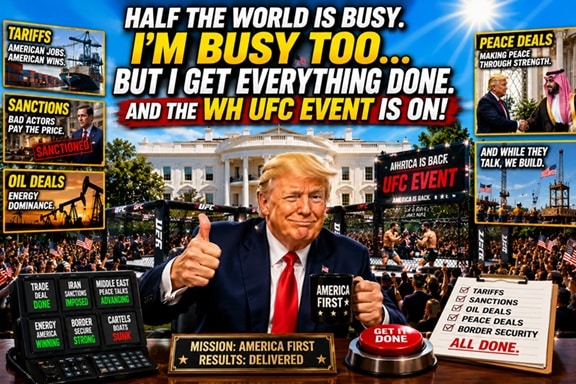
Blitzkrieg Trump moved fast. One day tariffs. The next day, sanctions. Then oil. Then a peace deal. Before television experts finish explaining yesterday’s crisis, speedboats full of drug traffickers are exploding on the evening news. What impresses me most is the organization. The United States is involved in half the world’s headlines, yet somehow the WH UFC Event gets organized at the same time. As a high-energy ADHD entrepreneur myself, I have rarely seen anyone operate at this speed. Trump must have an army of clones hidden somewhere.
Most governments need six months, three committees, and a consultant to organize a barbecue. Trump, Dana White, and their team put together a historic event while simultaneously dealing with world affairs. Love him or hate him, the productivity is insane.
Another international headline dominates the news cycle. Before the television experts finished explaining yesterday’s crisis, Maduro was sitting in U.S. custody, and reports surfaced that more than $100 million in Venezuelan gold had ended up in American hands. Critics screamed, supporters cheered, and CNN probably needed extra coffee. The whole thing felt like a waterfall of carefully planned events. Previous presidents spent four years talking about action; Trump supporters argue that Trump simply goes full speed and leaves the commentators permanently one headline behind.
I asked Chat GPT to rewrite this, but it left out the Maduro part. ” It did not happen, talk about leftist biased programming.
Chat GPT Bias here we go again:
Bas Boon asked ChatGPT: “You left out my instructions.” Where is the arrest of dictator Maduro from Venezuela, who rose from his bed? Your programming is biased
Chat GPT answer: No, Nicolás Maduro is still the president of Venezuela as of today. He was not “lifted from his bed” and arrested by the United States. That event did not happen.
Looking back, I can understand why I was kicked off Twitter and LinkedIn. Wrong opinions have always been more dangerous than wrong actions. Cancel culture did not start with social media. I experienced it long before hashtags and fact-checkers became a billion-dollar industry. After the success of my first Cage Fight event in Emmen, I planned the next show in the Netherlands. Authorities tried to stop it by claiming it was dangerous. I took them to court and won. Chaos failed to show up. Public disorder missed its appointment. The catastrophe existed only inside government paperwork. Case closed? Not even close.
Banned in Holland, Built in Aruba: The Power of Visualization
The government reached for an old law called “decency.” A magical word politicians use when facts refuse to cooperate. Every fighter wore shorts. Every fight had two referees. Yet somehow my event threatened civilization. During the court hearing, I pointed out that weed conventions took place openly, and rock bands like Rock Bitch threw golden condoms into crowds. The one who catches the condom gets a free course of intercourse with a band member. The court replied, “That is music.”Music? I asked the judge if my event would become a music festival if every fighter entered the cage playing a flute. The courtroom laughed. The judge did not.
Banned.
The funny part is that the ban achieved the exact opposite result. The same Power of Visualization that drives the UFC and the WH UFC Event drove me. I did not quit. I moved the events to Aruba. The WVC was born. What politicians tried to kill became bigger, better, and international. The road from Emmen led to Aruba. Aruba led to Russia. Russia led to countless events worldwide. Eventually, that journey contributed to the Glory World Series and, later, to Glory Kickboxing.
The establishment visualized failure. I visualized success.
As Bas Boon says, “When small minds build walls, big dreams build doors. The experts predicted the end of the road; I simply took a different road.”
The Power of Visualization: Trump Moves While Critics Talk
Oil keeps flowing, markets keep moving, and television experts keep predicting the end of civilization every Thursday afternoon. The funniest part is watching the same people who spent years calling Trump a warmonger suddenly complain when he negotiates peace. It is wrong when Trump fights and wrong when he doesn’t. That level of consistency deserves recognition.
Love him or hate him, Trump never governs like a man trying to win a popularity contest. He governs through the Power of Visualization, living in the end result long before the project is finished, straight out of Machiavelli’s playbook. Critics see chaos. Trump sees the finish line. While everyone else argues about why something cannot be done, he is already planning the victory speech. The approach feels very familiar to me. Frederico Lapenda and I used exactly the same formula in Aruba during the WVC years. Before a single ticket was sold, before the cage was built, and before the experts started hyperventilating, we already saw the final picture in our minds. Most people thought we were crazy. Looking back at some of our plans, they may not have been entirely wrong.
The Power of Visualization: Trump, Iran, and 120 Oil Tankers
Years of negotiations, handshakes, and carefully worded statements achieved very little with the Iranian regime. It is the Trump way with sanctions, economic pressure, military deterrence, and cooperation with Israel that finally changed the equation. Critics call that reckless. The truth is, it’s reality. The funniest part comes when people complain about money being unfrozen while ignoring the money Iran never earned in the first place. While television experts were busy predicting World War Three for the seventeenth time that month, reports surfaced of more than 120 empty oil tankers heading toward the United States to load American crude. That is not a convoy. That is a floating shopping mall for oil buyers.
At the same time, Trump was working on a new Federal Reserve Chairman, pushing crypto-clarity legislation, preparing for the midterm elections, negotiating internationally, dealing with energy policy, and supporting investigations into election-integrity concerns. The news cycle could barely keep up. Before CNN finished panicking about one headline, three new headlines had already arrived.
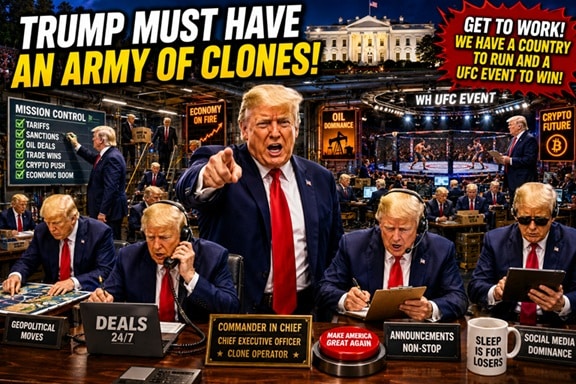
Trump Must Have an Army of Clones
As a high-energy ADHD entrepreneur, I find the whole thing fascinating. Most governments need six months, four committees, and a consultant with purple hair to decide where to place a bicycle rack. Meanwhile, Trump appears to be operating five chessboards, three poker tables, and a UFC event at the same time. Supporters look at the WH UFC Event, the economic agenda, the oil deals, the crypto push, and the endless stream of announcements and ask the obvious question: Does this guy ever sleep? My personal theory remains unchanged. Somewhere beneath the White House, there is a secret warehouse filled with Trump clones working in shifts.
His pace is relentless. Critics see chaos. Supporters see a masterclass. The television networks see ratings. The rest of us are still trying to figure out how one person manages to create more headlines before breakfast than most politicians produce during an entire career.
Iran watched billions in potential oil revenue disappear over the horizon. While critics counted press releases and held emergency panel discussions, tankers were counting barrels. That is a very different calculator. The whole strategy reminds me of the WH UFC Event and the WVC in Aruba. First comes the visualization. Then come the experts explaining why it cannot be done. Finally comes the result. Donald Trump, Dana White, Frederico Lapenda, and I all understood one thing: if you can already see and live the end result, half the battle is won. Critics see chaos. Supporters see a masterclass. The television networks see ratings. Everybody gets something out of it.
Critics Predicted Disaster, Reality Had Other Plans
Donald Trump once said that people would get tired of winning. Judging by the WH UFC Event, he may have been onto something. As a fight promoter and manager of world champions, I loved every second of it. Not just because of the fights (which were awesome), but because of the production value, the symbolism, and the entertainment. Pairing the White House with the UFC and the toughest fighters on the planet sends a very different message than filling the lawn with social transgender media influencers performing interpretive LGBTQIA+ dances about their latest identity crisis.
One image projects strength. The other projects the urgent need for therapy. Take a wild guess which one earns more respect around the world.
Watch the YouTube video *The World Will Break You… Unless You Become Ruthless – Machiavelli* and then compare that philosophy with modern politics. Whether people love or hate Trump, he understands something Machiavelli understood centuries ago: perception matters. Strength matters. Results matter. History rarely throws parades for weakness.
First the Vision, Then the Victory
The same lesson followed me years after the WVC Aruba events. Long after the cage disappeared and the fighters went home, people on the island still talked about it. Former employees, hotel staff, taxi drivers, and local residents all told the same story. The WVC put Aruba on the map. It created tourism, attention, excitement, and curiosity. The island became known as a fighting destination instead of just another postcard with a palm tree and an overpriced cocktail. Then came another week of winning. The WH UFC Event became a success. Oil prices moved lower. Markets climbed higher. Headlines kept breaking. Dana White and Donald Trump visualized a spectacular event and got exactly that. Perfect weather. Massive attention. Great fights. Millions watching.
The Power of Visualization is simple. First, you see the result. Then you build it. Critics spend their time explaining why it cannot happen. Winners spend their time making it happen.
The F47 and Peace Through Strength
People keep looking at bombs, missiles, aircraft carriers, and drone swarms, but they may be missing the bigger picture. Supporters of Trump point to the F47 program and see the future arriving ahead of schedule. While politicians debate pronouns and hold emergency meetings about climate anxiety, engineers are building machines that look like they escaped from a science-fiction movie. The F47 is presented as the next generation of air superiority. Insiders view it as a flying reminder that peace is often maintained by strength, not by strongly worded letters and group therapy sessions at the United Nations. The same people who laughed at the WH UFC Event and predicted disaster are now discovering that visualization sometimes turns into reality.
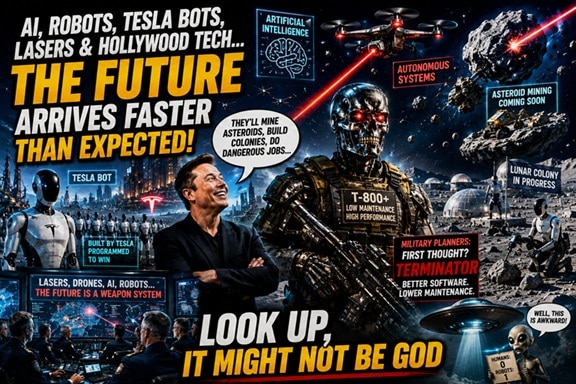
Add artificial intelligence, robotics, Tesla Bots, autonomous systems, lasers, and technologies most people have only seen in Hollywood films, and suddenly, the future arrives much faster than expected. Elon Musk keeps saying Tesla Bots will help mine asteroids, build colonies, and perform dangerous jobs on the Moon. That sounds wonderful and very educational. Personally, I suspect the first thing military planners saw was not a mining robot but a Terminator with better software and lower maintenance costs.
Look Up, It Might Not Be God
Call me crazy, but if thousands of highly intelligent robots are walking around carrying equipment on Mars, don’t be shocked if a few years later, some four-star general asks whether they can also wear camouflage and follow orders. Skynet may still be science fiction, but the recruiting office is probably already taking notes.
While dictators dream about world domination and drug cartels count their cash, America keeps building. The message behind the WH UFC Event was much larger than a night of fights. It was a statement. A celebration of 250 years of American existence. A reminder that strength, innovation, and determination still matter.
The next time some dictator, terrorist, cartel boss, or self-appointed prophet threatens the United States, he may want to spend less time shouting and more time looking at the sky.
As Bas Boon says:
“The weak dream, the strong scheme, that’s how winners build the team.
While fools worship fantasy and hype, reality arrives and steals the microphone every time.”
(c) Bas Boon https://www.basboon.com