
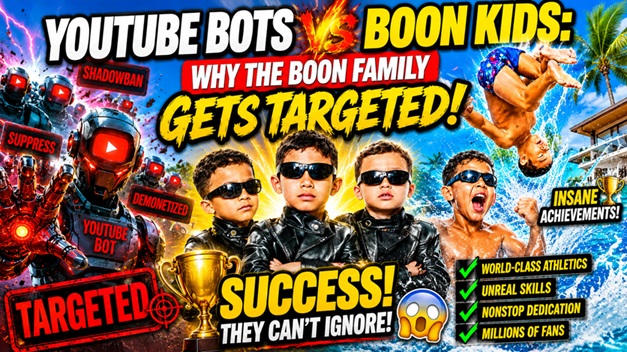
YouTube Bots vs Boon Kids: Why the Boon Family Gets Targeted
We Asked YouTube’s Own AI Why the Boon Kids Channel Was Barely Being Distributed Despite Outrageously High Engagement Metrics.
Recently, YouTube Studio introduced a feature called “Ask AI,” which supposedly helps creators understand why videos perform well, why viewers react emotionally, and how the algorithm interprets retention, engagement, and audience loyalty. Naturally, I tested this shiny new artificial intelligence system on the Boon Kids channel. If any channel can expose the complete absurdity of modern YouTube, it is probably three chaotic children from Thailand, behaving like tiny stuntmen who escaped from a low-budget action movie filmed beside swimming pools and speedboats.
Ironically, the AI analysis itself practically confirmed that YouTube and Google were targeting and discriminating against high-performing children from Thailand despite the channel generating unusually strong retention, replay behavior, emotional audience reactions, and authentic engagement across multiple Shorts videos.
The hilarious part about this experiment was not that the AI disagreed with me. YouTube’s artificial intelligence openly confirmed almost everything I had said for years. At the same time, the platform still refused to distribute the videos properly. The system admitted that viewers constantly replayed the content. Audiences watched longer than average users. They reacted emotionally in the comments.
The Shorts also generated unusually strong audience retention across multiple videos.
YouTube bots reward another emotionally bankrupt AI voice reading “Top Ten Minecraft Secrets” over stolen gameplay footage while they target real kids’ content showing a fearless three-year-old performing a pool salto, and millions of viewers slowly lose their remaining brain cells in real time.
Why Does a Three-Year-Old Ken Boon Performing an Insane Pool Salto Get Almost No Algorithm Push Despite Millions of Similar Viral Kids Videos?
So naturally, I asked YouTube’s shiny, futuristic AI masterpiece this question because, apparently, we now live in a timeline where creators interrogate robots while the robots quietly decide which videos deserve to exist.
Ken Boon was three years old during that video. Most toddlers at that age still fight emotional wars against broccoli and occasionally forget how legs work while walking across living rooms. Ken apparently skipped directly toward becoming a miniature Thai stuntman with absolutely no respect for gravity, danger, or the blood pressure of nearby adults.
The video lasted only a few seconds, yet viewers replayed it so aggressively that the average percentage viewed climbed above 191 percent. Human beings literally watched this tiny, fearless lunatic throw himself through the air and collectively decided:
I need to watch that Ken Boon Salto again because the algorithm refuses to cooperate with reality anymore.”
Then YouTube’s own AI admitted that the engagement was extremely strong, the retention was far above average, and nearly 65% of viewers stopped scrolling to watch the video.
Apparently, another emotionally exhausted AI narrator reading “Top Ten Minecraft Secrets” over stolen gameplay footage remains more culturally important than a three-year-old flying through the air like a tiny action hero while real kids content gets targeted by the algorithm.
Why Are People Rewatching Boon Kids Videos Like the algorithm depends on it?
According to YouTube’s own AI analysis, viewers replayed the videos because the content triggered authentic surprise, emotional reactions, unpredictability, disbelief, and genuine human chaos. Nobody rewatches fake family vloggers who pretend to be shocked because someone switched apple juice for orange juice, while everybody delivers emotional reactions with the acting quality of haunted IKEA furniture.
The Boon Boys are different.
One moment, Conan lands a perfect backflip beside the swimming pool because he wants to impress a girl nearby. The next moment, Kato immediately copies the stunt and crashes flat on his back with the elegance of a refrigerator falling out of a moving truck. Then little Ken joins the competition despite still being young enough to believe danger is probably an imaginary adult conspiracy.
That unpredictability forces viewers to keep watching because literally nobody knows what will happen next. The videos feel alive. The chaos feels authentic. The reactions feel real rather than manufactured in influencer laboratories powered entirely by ring lights and fake enthusiasm.
Why Does the YouTube Algorithm Push Fake Garbage While Real Boon Kids Content Gets Targeted as Inauthentic?”
Everywhere you look on modern YouTube, you see the exact same garbage repeated endlessly, as if humanity collectively decided that fake reactions should replace actual entertainment.
Scripted pranks.
Forced crying scenes.
Manufactured family drama.
Overacted reactions designed for thumbnails where everybody looks like they accidentally witnessed an alien invasion inside Walmart.
Entire channels behave like malfunctioning Disney auditions filmed under bright LED lights, with everybody smiling with the emotional sincerity of supermarket mannequins trying to sell toothpaste.
At the same time, the Boon Family uploads impossible-kids content filmed in Thailand, showing toddlers performing underwater world-record-level swimming, insane pool-salto stunts, and athletic chaos that most adults would never even attempt without first signing medical waivers, yet YouTube bots and targeted algorithms still suppress the content.
Then YouTube’s AI bots openly admitted something completely ridiculous:
The audience loved it.
The statistics from the Ken Boon pool salto Shorts video looked completely insane for what was basically a microscopic algorithm test on a channel with almost 100,000 subscribers.
YouTube’s bots looked at a fearless three-year-old flying through the air like a miniature Thai stuntman escaping an explosion scene and somehow decided: “Excellent content. Let us now carefully test this masterpiece on seven illiterate camel drivers somewhere in Afghanistan before showing it to the actual subscribers.”
Even those imaginary camel drivers apparently kept watching.
YouTube Statistics – Ken Boon Pool Salto Shorts
Then YouTube Bots and AI Openly Admitted Something Completely Ridiculous About Kids Content
YouTube Statistics — Ken Boon Pool Salto Shorts
| Statistic | Result |
|---|---|
| Stayed Watching | 65.8% |
| Swiped Away | 34.2% |
| Unique Viewers | 93 |
| Watch Time | 0.6 Hours |
| Average View Duration | 0:17 |
| Channel Pages Traffic | 80.0% |
| Shorts Feed Traffic | 13.3% |
| Playlist Traffic | 6.7% |
| Other YouTube Features | 0% |
The Shorts feed barely pushed the video at all. Only 13.3% came from the Shorts system itself, which means YouTube bots and the algorithm effectively targeted the content and locked it in a digital basement while loyal subscribers had to discover it manually, like archaeologists uncovering forbidden ancient footage hidden beneath the pyramids.
Why Did Conan Boon’s Real Backflip Get Less Algorithm Push Than Fake Family Garbage and YouTube Bots?
After seeing the Ken Boon (3 YEARS OLD) statistics, I obviously asked YouTube’s AI another question because, apparently, I enjoy psychologically torturing myself with analytics now.
I asked:
“How exactly does Conan Boon landing a real backflip while trying to impress a girl at the pool receive less push than fake prank channels filmed by influencers with the emotional authenticity of airport furniture?”
YouTube Statistics — Conan Boon Backflip Shorts
| Statistic | Result |
|---|---|
| Viewers Staying After First Seconds | 129 |
| Unique Viewers | 99 |
| Watch Time | 0.8 Hours |
| Average View Duration | 0:20 |
| Statistic | Result |
|---|---|
| Viewers Staying After First Seconds | 130 |
| Stayed Watching | 56% |
| Unique Viewers | 99 |
| Watch Time | 0.8 Hours |
| Performance Compared to Normal | 0.2 Lower Than Usual |
| Average View Duration | 0:20 |
| Retention Analysis | Approx. 200% Retention on a 10-Second Short |
YouTube owns a platform with billions of users, yet YouTube bots and targeted algorithms still suppress the Boon Brothers channel despite nearly 100,000 subscribers and authentic kids content featuring genuine humor, real reactions, impossible stunts, emotional chaos, and childhood athletic ability that fake family channels could never replicate under studio lights.

Then the algorithm apparently decides:
“Perfect. Let us test this content on twelve confused camel drivers, one goat farmer, and a guy repairing sandals somewhere near a mountain before considering distribution.”
Audience retention remained extremely strong across the Boon Kids videos, yet YouTube bots and targeted algorithms still failed to properly push the content, even as average watch duration was well above normal Shorts levels. Viewers clearly stayed emotionally invested in the Boon Brothers content rather than instantly scrolling away to another piece of algorithmically friendly garbage. Audiences filled the comments with genuine disbelief, humor, and emotional reactions to the chaos surrounding Ken Boon, Conan Boon, and Kato Boon. Viewers also replayed the videos repeatedly to watch the impossible stunts, underwater swimming, and fearless pool challenges, even while the system targeted the content.
Which means the actual problem was never the Boon Family content itself.
Distribution through the algorithm remained the real issue from the beginning.
Why Are Comments So Important in the YouTube Bots vs Kids Algorithm?
YouTube’s own AI openly admitted that the emotional reactions in the comments served as strong signals of the channel’s authenticity. People reacted with genuine disbelief because they honestly could not process what they had just watched.
Some viewers compared Kato to Jim Carrey because his natural energy feels completely insane in the funniest possible way, while others described Ken as fearless because normal toddlers do not casually attempt stunts that would terrify fully grown adults with mortgages, anxiety disorders, and lower back pain, yet this kind of real kids content still gets targeted by the algorithm.
That matters because emotional authenticity cannot easily be manufactured.
Bots can fake clicks, manipulate likes, and manufacture engagement statistics all day long, but no artificial system can fake thousands of viewers reacting with genuine shock after watching a two-year-old unexpectedly destroy his older brothers during an underwater swimming challenge, while one sibling nearly bursts into tears because his tiny brother publicly humiliated him in front of the entire Boon Family.
Why Does the Platform Still Refuse to Properly Push This Kind of Original Content?
Now we arrive at the funniest and most ridiculous part of the entire experiment because even YouTube’s own AI could not really explain the contradiction anymore. The analytics clearly showed strong retention, constant rewatches, emotional audience engagement, and unusually loyal returning viewers across multiple Shorts.
Under normal circumstances, those engagement signals should trigger aggressive distribution in the YouTube Bots vs Kids algorithm because that is supposedly how the system decides what kids’ audiences enjoy watching.
Instead, many Boon Kids videos disappear into the algorithmic graveyard while another fake reaction channel uploads “TRY NOT TO LAUGH IMPOSSIBLE CHALLENGE PART 927” and immediately receives enough promotion to invade several small countries simultaneously.
At some point, you have to ask the obvious question:
At some point, you genuinely have to ask what exactly YouTube bots and targeted algorithms reward anymore because originality clearly no longer matters, authentic family chaos clearly no longer matters, and emotional audience connection apparently ranks somewhere below fake reaction thumbnails featuring adults pretending somebody just launched a nuclear missile inside the kitchen.
The Boon Boys are accidentally creating some of the funniest, most chaotic, and most unbelievable family content anywhere on the internet simply by existing near swimming pools in Thailand, while the platform still behaves as if it has absolutely no idea what it is looking at.
Honestly, maybe that explains modern YouTube better than any analytics report ever could.
“When real chaos gets hidden while fake chaos gets deployed, eventually even the smartest robots become unemployed.”
YouTube flagged the Boon Family Channel as Mass-Produced.
https://basboon.com/youtube-flagged-boon-family-channel-as-mass-produced/
— Bas Boon http://www.basboon.com