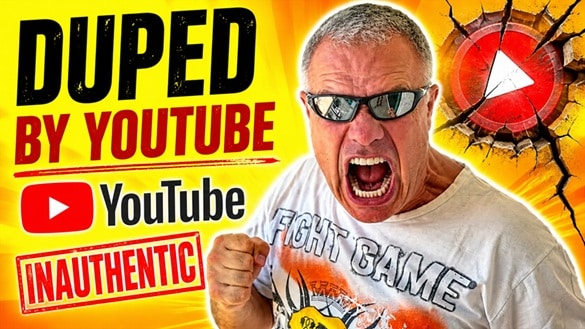
“Thousands of hours… labeled ‘inauthentic.’”
YouTube Not Recommending Any Video: Shadowban and Demonetization!
What is happening right now with YouTube not recommending videos?
Let me start this in the only honest way possible. At this point, I’m no longer trying to understand YouTube — I’m trying to survive it. What’s happening right now goes far beyond the usual “algorithm is tricky” explanation that gets thrown around like a motivational quote for creators. This isn’t about uploading at the wrong time or picking the wrong thumbnail color. This is the kind of situation where the system effectively puts your entire channel into a digital witness protection program: it still exists, but nobody gets to see it. YouTube actively shadowbans the channel while stacking demonetization on top, like that’s part of the system.
My videos are one-of-a-kind, completely unique content!
I made a video called “Boondogs Bark and Roll,” and this wasn’t some quick upload thrown together in five minutes. This was one of those videos where everything actually works: singing dogs, my three-year-old playing boogie-woogie piano like he just walked out of a jazz club in 1952, animations synced, humor in place, and, most importantly, something original. Something real.
Exactly the kind of content YouTube constantly claims it wants more of, especially now that half the platform is turning into automated factories pumping out endless recycled nonsense.
At this point, it no longer feels like a theory. It feels like proof that the channel has been shadowbanned for over two years and is now being demonetized on top of that. This whole situation feels like YouTube isn’t recommending video content for reasons unrelated to performance.
And what happens?
“This is exactly what it feels like when YouTube is not recommending video content at all.”
Not a slow start, not a weak push, not a “let’s test this with a small audience.” Just nothing. The algorithm looked at it and decided this was not something humans should experience, which is a bold decision, considering humans are the target audience.
So, naturally, like every creator who still believes in logic, I went to check the analytics, expecting at least some explanation that would make sense.
That’s where things stopped making sense completely.
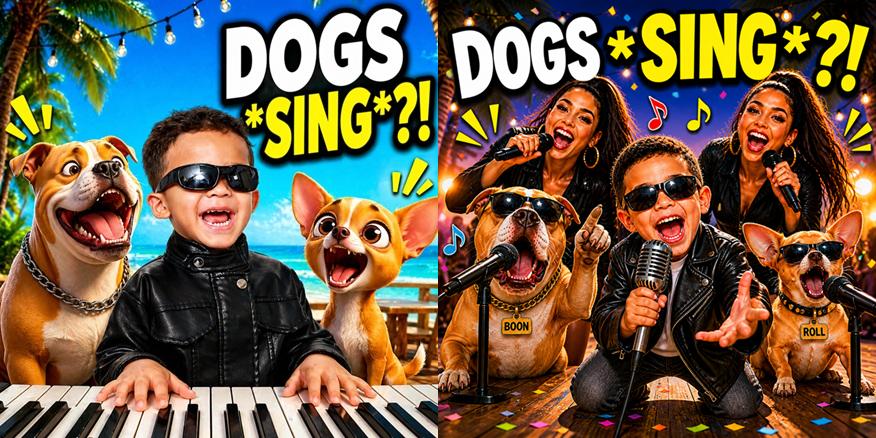
“Boondogs Bark and Roll… ‘inauthentic,’ not wanted, and quietly buried.”
YouTube Not Recommending a Video: Shadowban and Demonetization Combined
Because when you actually look at the numbers, they don’t tell a story of failure; they tell a story of something that should be working perfectly fine. The impressions are around 574, which already explains why the video is not taking off: if nobody sees it, nobody can click it. That part is simple. But then you look at the click-through rate, which is around 7.3%, and suddenly the story changes completely, because that means when people do see the video, they actually click on it. That’s a strong signal, not a weak one.
Statistics of my new YouTube video.
Then it gets even better. The average watch time is around one minute and forty-five seconds on a video that’s just over two minutes long, which means people are watching roughly eighty percent of the video. In normal YouTube logic, this is the part where the system says, “This is engaging content, let’s show it to more people.” Instead, YouTube ignores all of that and keeps the video exactly where it is, hiding it like some kind of secret nobody is allowed to discover. It clearly doesn’t show the video even to subscribed viewers. And as a final touch, YouTube demonetizes it.
To make it painfully clear how ridiculous this is, here’s the breakdown in a way even the algorithm should understand:
| Metric | Result | What It Actually Means |
|---|---|---|
| Impressions | 574 | Almost nobody sees it |
| CTR | 7.3% | People click when they see it |
| Views | 187 | Limited by exposure, not interest |
| Unique Viewers | 80 | Mostly real engaged viewers |
| Avg Watch Time | 1:44 / 2:13 | Strong engagement |
| Avg % Watched | 79.2% | People stay |
| Browse Features | 7.8% | YouTube barely pushes it |
In other words, this is a clear example of YouTube not recommending video content despite strong performance signals.
So people click, people watch, people stay, and YouTube responds by doing absolutely nothing. At this point, you are no longer optimizing content; you are trying to understand why the system ignores its own signals.
YouTube Not Recommending a Video: Shadowban or Algorithm Problem
Now, if this were just one video, you could still convince yourself it’s just the timing. Bad luck. Maybe the algorithm is having a bad day, or maybe someone unplugged something important. But this is where things start to feel very different, because it’s not just one video; it’s everything. That’s the moment when “shadowban” stops sounding dramatic and becomes the only logical explanation left, especially as visibility drops and demonetization quietly limits everything in the background.
So I started testing. Proper testing. I upload a video, then check it from another account. Nothing. I ask family members, people who are subscribed and actually watch every upload because they want to see it. Nothing shows up. The videos don’t appear in their feed. Nothing is hidden or delayed; just completely absent. It’s like the videos were never uploaded in the first place, which is exactly how a shadowban looks in practice.
So I documented it because, at this point, I don’t trust anything unless I can show it. I made a video where you can literally see what’s happening, and that’s where things go from strange to completely absurd.
Black screen. Sound works. Text works. Apparently, the visuals were too “authentic” to be shown.
YouTube Not Showing Videos to Subscribers and Black Screen Glitch: Proof of Suppressed Content
In the video I uploaded to my website, you can clearly see two things happening at the same time, making this impossible to ignore. First, the video itself plays on a black screen, while the audio works perfectly and the text remains visible, which already raises a very basic question: how does something like that even pass through the system without being flagged as broken? But more importantly, I scroll through my son’s iPad—someone who watches every video I upload—and there is not a single family video in his feed. Not one. It’s like the channel doesn’t exist. This is exactly the kind of situation where YouTube fails to recommend video content despite strong engagement. From here, it becomes clear that the issue is not reach, but delivery.
The same thing happens with the nanny, who likes and comments on everything—exactly the kind of viewer YouTube claims it wants to prioritize. Nothing shows up in her feed either. Then I check with my nephew and other family members, and the result stays exactly the same. No recommendations. No trace of the videos. At that point, this is no longer a reach problem or a performance issue. The content is simply not being delivered to the people who are actively looking for it, which is increasingly looking less like an algorithmic decision and more like a shadow ban in practice.
There is a pattern!
At this stage, it becomes clear that YouTube is not recommending videos to even the most engaged viewers, which is exactly the opposite of how the system is supposed to work. The pattern becomes clear. The platform is not pushing the content, regardless of performance, engagement, or viewer intent. And when that happens consistently, it is very hard to describe it as anything other than suppressed visibility combined with silent limitations that look a lot like demonetization affecting reach.
Combine that with a video that plays on a black screen, and it becomes even harder to explain this as normal behavior. At that point, it stops looking like a glitch and starts to look like a system failure that goes far beyond what you would expect from a platform that claims to prioritize quality content.
Why fix the problem when you can remove the appeal button instead?
YouTube Appeal System Broken: Manual Approval, Instant Re-Block, and Disappearing Appeals
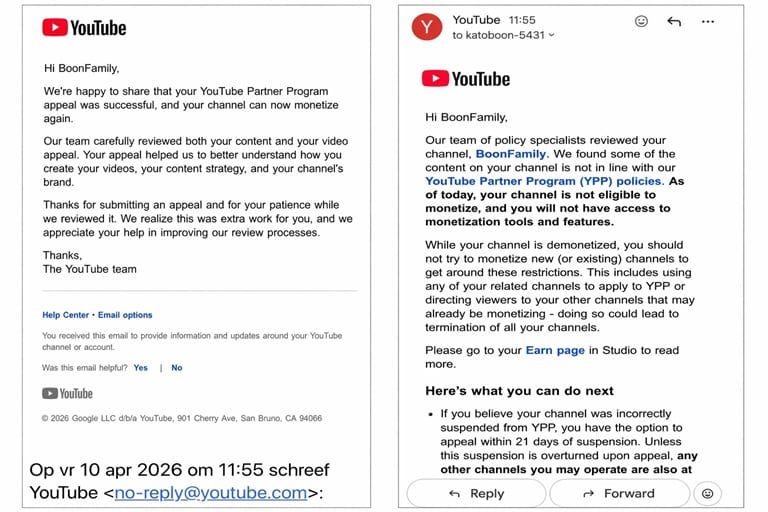
And if that wasn’t enough, this is where things move into territory that honestly feels like it shouldn’t even be possible. I showed on my website that the channel was manually reviewed and approved, meaning a real human being looked at it and decided everything was fine. For a brief moment, it felt like the system corrected itself.
Six hours later, it was blocked again.
Same issue, same label: “Inauthentic content, large scale produced, pointing out I am a bot?”, like nothing ever happened. So naturally, I try to appeal again, because that is the process you are supposed to follow. Except this time, the appeal button doesn’t work. Not partially, not slowly, but completely useless. So I record that as well, because at this stage, everything needs proof.
And later, the system tells me that the appeal period has expired.
“Something went wrong”… and it will keep going wrong. Enjoy the loop.
Then the appeal option disappears completely.
Gone. Just like that. Like it never existed. Which is impressive in its own way, because later the system tells me that the appeal period has expired. That means I apparently missed a step in a process that the system itself removed. That is not just broken logic. That is almost creative.
And through all of this, the pattern stays exactly the same. Shadowbanned visibility continues. Demonetization sits quietly in the background. Decisions get reversed without explanation. The system behaves like it’s making it up as it goes along.
At that point, you are no longer dealing with a structured platform. You are dealing with something that creates rules, breaks them, and then expects you to somehow keep up.
When You Can’t Even Say “Boobs” on YouTube (But “Big Chest” Works Fine)
If you thought YouTube and Google were the only problems, think again. Here’s what the rest of the headache looks like. I tried to make a thumbnail with girls playing in water during Songkran. Completely normal here in Thailand. Nothing strange. Nothing extreme. Just people having fun. But the moment I describe anything even slightly realistic, the system shuts it down. I can’t say “boobs.” I can’t describe anything directly. Everything gets flagged as if I’m doing something illegal, instead of just describing humans as existing.
So what do you do?
You adapt.
I start changing the prompt completely. I describe them as participants in an LGBTQ beauty contest. Part of Thai culture. Playing in a traditional water festival. Suddenly, the system relaxes. The system works, understands, and suddenly becomes culturally acceptable, which apparently depends entirely on wording, not reality.
And then, instead of saying anything directly, I say “big chest,” because that’s apparently the only way to describe reality without the system breaking down. I can’t say it normally. I have to rephrase everything as if I’m writing through a censorship filter designed by someone who has clearly never seen a human body outside of a diagram.
And guess what.
That works.
Prompt Circus
After hours of fighting it, rewriting prompts, testing different angles—basically reverse-engineering how the system thinks—it finally produces something usable. Not because it’s difficult, but because the system itself is inconsistent and full of holes.
So now I’m not just making thumbnails. I’m manipulating prompts, using cultural context, switching wording, and carefully navigating invisible rules like I’m solving a puzzle that changes every five minutes.
And after all of that—after outsmarting multiple layers of AI just to create a basic scene—the result still lands in the same place: shadowbanned visibility, demonetization quietly waiting in the background, and the final label that somehow explains everything and nothing at the same time:
👉 “Inauthentic content.”
Which is honestly incredible. Because if this is inauthentic, then I would really like to meet the bot that is apparently doing it better—preferably one that doesn’t need four and a half hours of negotiation just to describe reality.
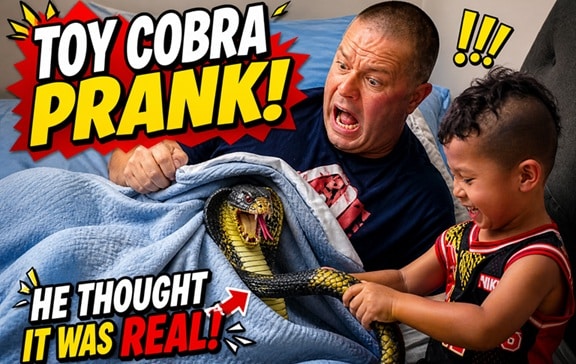
This “snake prank” image with a toy snake… took 3 hours to make.
Asked AI to Follow Its Own Rules… That Was the First Mistake
And just when you think you’ve figured out how to outsmart the system, this is where things go from difficult to completely absurd. Now you are not just fighting AI. You are arguing with it like it’s a confused employee who got promoted way too early and now makes decisions with full confidence and zero understanding.
At some point, I actually start quoting ChatGPT back to itself, something I never expected to do in my life. I literally tell it, “Make a thumbnail within your own guidelines and rules.” Because logically, if anyone should understand what is allowed and what is not, it should be the AI itself. It’s your system. Your rules. Your guardrails. You wrote the manual. Just follow it.
Sounds simple.
It’s not.
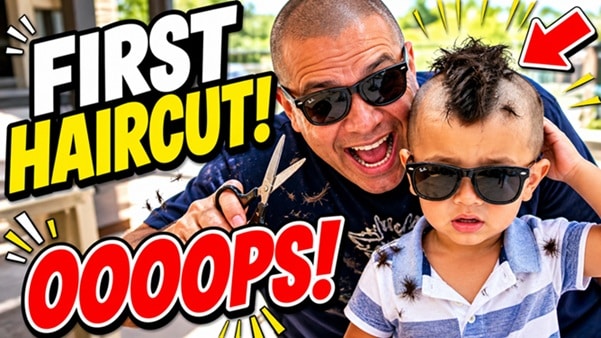
ChatGPT 2.0: Advanced AI… still scared of a bad haircut.
Haircuts, Runny Noses, Toy Snakes — Welcome to the ChatGPT 2.0 Ride
Because even when you tell it to stay within its own rules. It still manages to block itself, as if it’s protecting the internet from… itself. It gives an explanation. Then contradicts that explanation five minutes later. Then blocks the same thing again. It woke up from a nap and completely reset its memory. And this is where it gets even better, because now real life starts doing things the AI simply cannot handle.
I had this completely normal, ridiculous moment with my kid, Kato Boon. He had the flu, and here in Thailand, they use saline, basically salt water, to rinse your nose. So I’m filming, just casually, and suddenly the biggest boogie you’ve ever seen comes out of his nose… and of course I catch it on camera.
Perfect real-life moment. Funny. Harmless. Exactly the kind of thing people actually watch.
And I already know what happens next. Try to describe it? Blocked. Try to generate something similar? Flagged. Try to keep it realistic? Not allowed.
So now even reality needs editing before the system accepts it.

ChatGPT 2.0: One runny nose, 3 hours, and somehow still not allowed.
Bomb Disposal Manual
At some point, it even tells you exactly what the problem is, something like “child plus realistic detail equals auto-block.” So you adjust everything, carefully, respectfully, like you’re following instructions in a bomb-disposal manual, where one wrong word might blow up the entire prompt.
And it still refuses.
You know by now that you are no longer dealing with logic. You are dealing with a system that explains rules, breaks rules, and then punishes you anyway. And no matter how carefully you follow everything, you still hit the same wall. The same pattern. The same result that starts to feel very familiar: shadowbanned visibility, demonetization quietly waiting in the background. Progress is blocked, like it’s part of the design.
And somehow, after all of that, after following every rule better than the system itself,
it still says no.
When Even ChatGPT Can’t Follow Its Own Rules
So now you are not just creating content. You are debugging the logic of an AI that is supposed to be smarter than you. That is a very humbling experience, because you quickly realize the AI is confident, not correct. And this is where it turn into next-level frustration. I even upgraded and moved to the newer version, thinking this would finally fix things… which was optimistic. Maybe this is where it becomes smoother. Faster. More intelligent.
No.
Now it just refuses faster.
My welcome trailer… which I can’t set as a welcome trailer because the button vanished. Perfect.
Which is honestly impressive. It’s like upgrading from a slow “no” to a premium, high-speed “absolutely not.” The system doesn’t improve your workflow. It optimizes your frustration so you can reach peak annoyance in record time. At this point, I sit there asking an AI to follow its own rules. It keeps breaking them. Explaining them. Redefining them. Then ignoring them again—all in the same session, like it’s running a one-man contradiction marathon with full confidence and zero awareness.
I am becoming an AI Prompt Professor!
And after hours of this—after rewriting prompts like I’m studying for a legal exam, after trying different angles, different wording, different emotional tones, and different levels of “please just work” desperation—you finally get something usable. Not because the system is clear, but because you accidentally hit the magic combination of words that doesn’t trigger its internal panic button. And as expected, YouTube’s reward is instant demonetization.
And just when you think you’ve finally won, after seven hours of wrestling with an AI to give you a usable image, the next level unlocks like a game you never signed up for. Now you have to animate it, upscale it, make it move—which means jumping into Runway, Kling, Pika, Hailuo, Hedra, or whatever tool feels like cooperating that day.
And guess what.
Same story.
Different AI.
Does AI listen to any prompt at all?
One breaks the motion like it forgot what movement looks like. Another distorts the image until your dog looks like it’s going through an existential crisis. Another ignores half the prompt, like it only read the first sentence and said, “good enough.” And another just creates something completely unrelated. You ask for a singing dog. It delivers abstract art with confidence.
So now you are not solving a problem. You are reliving the same problem across five different platforms. Each has its own personality. Its own rules. Its own creative way of saying “no.” And no matter what you fix or improve, you still end up in the same place: shadowbanned visibility. Demonetization is creeping in. Progress is blocked, like it’s part of the design.
And then, after all of that effort, all of that back and forth, all of that time spent trying to get multiple AIs to behave consistently, the result still falls under:
👉 “Inauthentic content.”
I’m not even frustrated anymore. I’m just impressed. Not by the technology, but by how something this advanced can still feel like it has absolutely no idea what it’s doing.
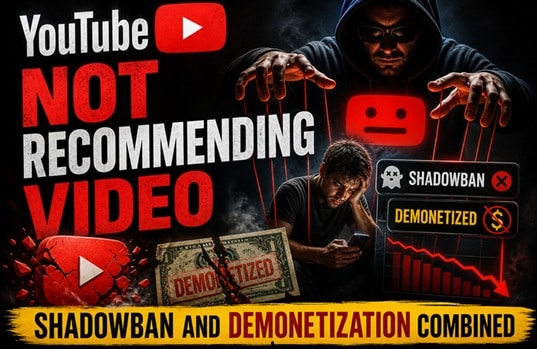
“Works perfectly… let’s hide it.”
YouTube Not Recommending Any Video: Shadowban, Demonetization, and System Failure Combined
So when you step back and look at the full picture, videos are not being recommended. Subscribers are not seeing uploads. Some videos literally turn into a black screen. Analytics show strong engagement. The appeal system breaks down. Monetization gets hit. Content creation becomes a battle against AI restrictions. And somehow, through all of that, the system still acts like everything is working perfectly fine.
Clearly, this is no longer about improving content.
This is YouTube not recommending any video at all. Shadowbanned. Demonetized. Quietly pushed out of visibility like it never existed in the first place.
And when that happens, it stops being a creator problem.
It becomes a system problem.
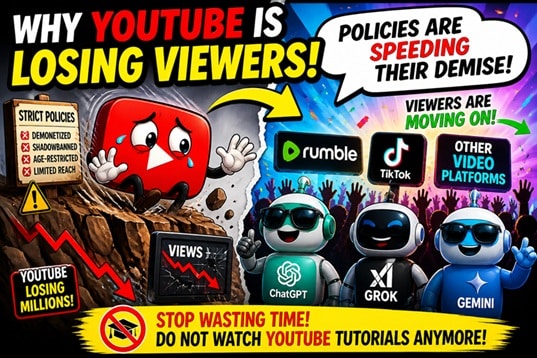
“Great Platform… Where Did Everyone Go?”
Why YouTube Not Recommending Videos Is Losing Viewers
And this is where it stops being just my problem and starts to look like YouTube is slowly sabotaging itself, which is honestly impressive. It had a system that worked. It still found a way to overcomplicate it into something that now struggles to recommend videos properly, while shadowbanning real content and mixing in demonetization as if it were part of the standard user experience.
Because if we’re being realistic, nobody opens YouTube to watch fifteen identical videos with the same title, the same structure, and the same fake excitement pretending to be original. People want something real, something different, something that feels human instead of mass-produced. Meanwhile, the algorithm decides what gets visibility and increasingly prioritizes what feels safest over what is actually best.
And here’s the real shift. People don’t watch 15- or 20-minute instruction videos anymore when they can type a few words and get an instant answer from ChatGPT, Grok, or Gemini. That makes YouTube’s original purpose—long-form instructions and explanations—slowly obsolete.
What makes it even more ironic is that the content actually works. People click, watch, and stay engaged… but somehow that’s still not enough. It still buries my content like I did something wrong, while pushing predictable, copy-paste content as if it were the safest option on the menu. It makes shadowbanned content disappear, strips momentum from demonetized content, and keeps rewarding the exact thing it claims to avoid.
“Raw Raw Raw I Am A Dinosauer, Rex Rex Rex, I Am an Apex 🦖
Dinosaur song eats baby sharks, aliens dance, Crazy Frog gets wrecked… clearly too much for YouTube.
Dinosaur Boon Brothers Dance Party Goes INSANE🦖🔥Music Video
CTR 7.8% — people click.
Watch time 2:02 — people stay.
Views 252 — mostly friends and family.
Recommendations from YouTube: zero.
Watch it yourself… You be the judge.
Another ‘viral’ video successfully buried 👍”
YouTube Not Recommending Video: Algorithm vs Real Content
And this is happening at the exact moment YouTube is competing with AI. People get answers instantly. Entertainment instantly. No friction. This should push YouTube to promote real creators and original ideas even harder. Instead, it hides them. It shadowbans them. It quietly stacks demonetization on top. Then it labels everything as “inauthentic,” which suddenly explains the outcome.
The reality is simple. People don’t leave platforms because they studied the algorithm. Nobody sits there analyzing CTR graphs for fun. They leave because it gets boring. Repetitive. Predictable. Same titles, same faces, same fake excitement pretending something is “insane” for the tenth time, like we all magically forgot the first nine. And now there’s no reason to wait. People don’t sit through 15-minute videos anymore when they can type a few words and get an instant answer from ChatGPT, Grok, or Gemini. Compared to that, most videos already feel outdated.
And that’s exactly what happens when originality gets buried instead of promoted. Real content gets shadowbanned. Copy-paste content gets pushed like it’s the safest option on the menu. Demonetization quietly removes incentive while the system pretends everything works exactly as designed.
So while I’m trying to understand why YouTube isn’t recommending videos that clearly perform well, the bigger question becomes obvious: Does the platform still promote what people actually want to watch? Or does it just promote what keeps the system comfortable and easy to manage?
Because right now, those two things are not the same. Not even close.
And if that continues. YouTube won’t be recommending content.
It will be a disappointment. With excellent consistency.
More “Inauthentic content.” — apparently the Boon Brothers’ specialty
YouTube, but we tried….
“Recommendations? Yeah, technically a few.
1,000 here, 5,000 there… just to the completely wrong audience.
A banana song is shown to astronaut viewers. Of course, they swipe. Perfect.
Then YouTube says: ‘See? Nobody watched. Inauthentic content.’
So let me get this straight… Google knows when you fart in a cave in the mountains of Afghanistan, but it can’t figure out where to place a video?
You get 500 characters of tags, a perfect SEO description, chapters, related videos… and the system still tests a dinosaur music video on ten astronaut lovers, then shrugs.
That’s not testing. That’s setting it up to fail.
At this point, it’s not a strategy… It’s a joke.”
What This Is Really About (Apparently “Inauthentic”)
Just to be clear, because common sense seems to have taken a long vacation without leaving a forwarding address, I’m not randomly throwing videos at the internet hoping something sticks like spaghetti on a wall. I actually have a point, a plan, and a ridiculous amount of effort behind everything I create.
My kids are the reason behind everything. The Boon Boys. The Boon Brothers. Everything revolves around them, which already puts this miles ahead of whatever “inauthentic content” is supposed to mean, especially when the system casually mixes shadowbanning and demonetization as if they’re part of the standard creator experience.
One day, they’re dancing with a baby T. rex like that’s completely normal parenting; the next day, they’re running a full band with poodles and pitbulls; and then suddenly they’re standing next to Jesus Christ, turning him into a rockstar, because apparently even Jesus needed a comeback tour and better branding in this algorithm.
Kids dancing with a baby T-Rex… clearly “inauthentic content.”
Boon Brothers is becoming a brand!
Black leather jackets, sunglasses, zero rules, music blasting, chaos everywhere—and right in the middle of that, you still get real family life, real moments, real memories, just slightly upgraded with dinosaurs, dogs, and creative decisions that probably make no sense to a machine but somehow work perfectly for humans.
That’s the whole point. Not trends, not copying, and definitely not mass-producing “content” like a factory trying to impress an algorithm that seems to reward repetition while quietly applying shadowbanning and demonetization in the background, like it’s handing out invisible trophies.
This is basically a family documentary, just one where the director clearly lost control and decided to add rock music, animals, and a T. rex because normal storytelling apparently wasn’t confusing enough.
And somehow, after all of that—after five days of AI battles, broken systems, invisible videos, what feels like a permanent shadowban sitting on the channel, demonetization popping up like a surprise feature nobody asked for, and me negotiating with machines like I’m arguing a legal case against a toaster…
👉 This gets labeled as “inauthentic content.”
So now I’m genuinely curious, because at this point curiosity is doing most of the heavy lifting.
If this is not authentic…
What exactly is?
What This Is Really About (Apparently “Inauthentic”) — Extended Reality Check
Just to make things even clearer, because context apparently packed its bags and left, this didn’t happen by accident or overnight. The channel was built from the ground up. It took an insane amount of hours. I handled the filming and editing myself, built every story from scratch, searched for locations, added humor, and kept it real instead of turning it into recycled, copy-paste content like half the platform seems to reward… which somehow still works better than this. And at the same time, YouTube confidently claims it doesn’t recommend unoriginal videos? Which is honestly impressive.
And because organic reach on YouTube clearly follows its own secret rules, I spent over 20,000 dollars to reach 100,000 subscribers. That was supposed to be the milestone, the moment where things improve, where the system finally says, “Alright, this guy is serious.” Instead, it quietly applies what appears to be a shadowban combined with demonetization in the background, like a reward system designed by someone with a dark sense of humor.
Instead, I hit 100K and watched the exact opposite happen. Growth stopped. Visibility dropped. The channel felt shadowbanned, like it exists just enough to keep me hopeful but not enough for anyone else to actually see it. And the only thing that increased? Confusion. Lots of it.
YouTube Shadowban, Demonetization, and 100K Subscribers Without Growth
There is no reward waiting at the top, no momentum, and no sign that YouTube is recommending videos any differently. Instead, everything starts moving in reverse. Subscribers don’t grow—they drop. The channel drops 500 subscribers like it’s part of some celebration package nobody bothered to explain. I followed the advice. I uploaded better content more often, exactly as influencers say to please the algorithm. Then YouTube hits the channel with demonetization twice and effectively shadowbans it for over two years, blocking it from reaching the audience it was built for.
To make it even worse, Google Ads’ “Demand Gen” system charges $5,000 to my credit card for something that was supposed to grow the channel, and I’m still waiting for an explanation, like it’s some kind of long-term mystery instead of something that should have been fixed immediately. And as a bonus, YouTube hits the channel with double demonetization on top. Perfect system.
These dogs? Too dangerous for YouTube. Bots made sure of it.
Two dollars a month from YouTube?
And here’s the irony: this was never about money. Two dollars a month is not exactly the kind of income that keeps someone going through demonetization, shadowban behavior, and visibility issues. If money had been the goal, I would have stopped somewhere between hour 500 and AI rejection number 2,000 and moved on.
I do this because I enjoy creating. I like building something from nothing. My kids love it, and my family can watch it from anywhere in the world. That’s the real reason behind all of this, not some broken monetization system that barely functions.
And somehow, after all that time, effort, money, frustration, creativity, and everything that clearly proves this is real content, the system still looks at it and decides:
👉 “Inauthentic content.”
And that’s where it really gets interesting.
When YouTube is not recommending video content across an entire channel, the problem is no longer content quality. It means the channel has effectively been shadowbanned.
Because I put in thousands of hours, built everything myself, created real moments, and made my kids part of it—not because I had to, but because I genuinely enjoy it. And the reward? Demonetization, disappearing buttons, and a system where I can’t even change my own welcome trailer anymore.
So if that is not considered authentic, then this is where YouTube should step up and say something honest for once:
“We got this wrong. We shadowbanned your channel for over two years, and our Google Ads system charged you around 5,000 without delivering real views or results (and flagged your channel forever).”
At that point, I’d read it twice just to make sure it isn’t another system error, then say, “Fine, keep the money. Just push the content properly for the two years I lost and show me what happens when the platform actually works.” And while you’re at it… send me my damn 100K YouTube plaque I never received.
That would be interesting for once. Real reach, real numbers, and real people actually finding the videos… instead of everything disappearing into whatever black hole the algorithm confidently calls strategy.
But instead of that level of honesty, the system goes right back to the usual explanation:
👉 “Inauthentic content.”
So what exactly is authentic?
Because from where I’m standing, this looks very human to me.
Bas Boon says:
Einstein needed 1,000 tries to crack his equation,
I’m at 5,000… and still can’t upload one “authentic” creation.
0 Views on YouTube? Why Your Videos Get 0 Views
https://basboon.com/0-views-on-youtube-why-your-videos-get-0-views/
(C) Bas Boon