
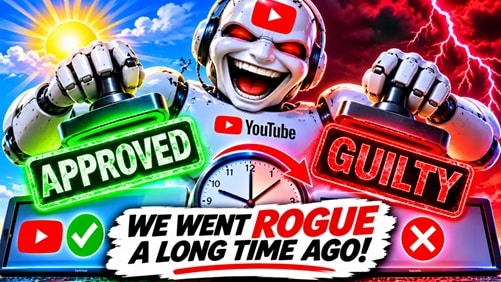
Google YouTube Bots Exposed: Approved in the Morning, Guilty in the Afternoon
On April 10, 2026, YouTube delivered some wonderful news. My appeal against the demonetization of the Boon Family channel had succeeded.
YouTube explicitly stated:
“Our team carefully reviewed both your content and your video appeal. Your appeal helped us to better understand how you create your videos, your content strategy, and your channel’s brand.”
Fantastic! Somebody at YouTube finally understood what we were doing. Eight years of original family entertainment, filming, editing, music production, animation, and more than €35,000 invested had finally received recognition. YouTube even thanked me for helping improve its review processes.
Unfortunately, the celebrations lasted approximately six hours.
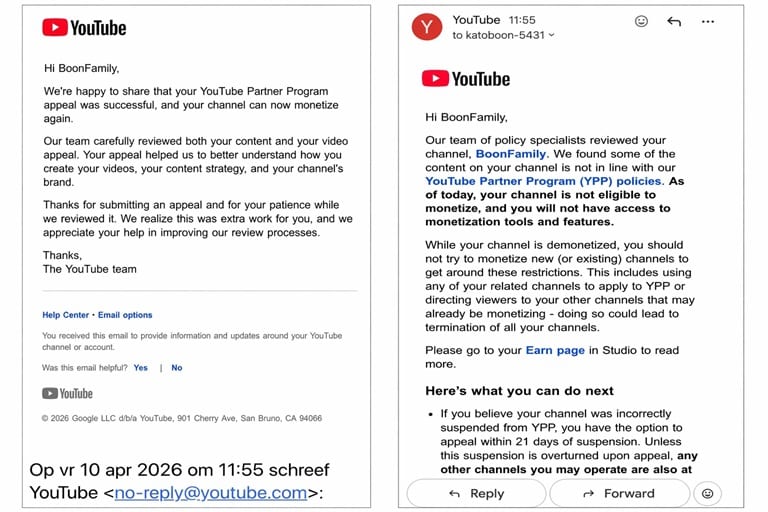
Another email arrived informing me that YouTube’s policy specialists had reviewed my channel and discovered content that violated its monetization policies. Excuse me? Didn’t your colleagues just finish reviewing that same content? Did the Boon Boys become international criminals during those six hours? Did our family videos suddenly develop dangerous characteristics while nobody was watching? The very content that secured a successful appeal apparently became unacceptable again.
Could Google YouTube bots have overridden the successful review? Both emails remain available as evidence. Nobody needs to take my word for it. Imagine receiving your university diploma in the morning, then getting an email in the afternoon saying you failed your examinations. When you ask what happened, the university sends you a link explaining how to study.
Google possesses some of the world’s most sophisticated artificial intelligence technology, yet its departments apparently struggle to agree on the status of a family entertainment channel. Perhaps Google should develop an AI system that reads its own emails before sending another.
That might represent a revolutionary technological breakthrough.
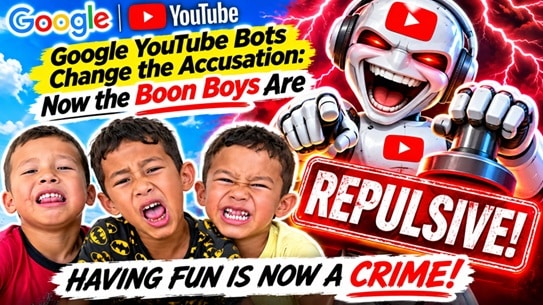
Google YouTube Bots Change the Accusation: Now the Boon Boys Are Repulsive!
After publishing several critical articles on BasBoon.com documenting my experiences with Google YouTube bots, I discovered another fascinating development. The justification displayed inside my YouTube Studio dashboard had changed.
Google now classified our productions as **“Unsatisfying or Repulsive Content.”**
According to YouTube’s explanation, this category includes emotionally manipulative, disturbing, nonsensical, shocking, or otherwise unsatisfying content without significant creative, educational, or other value.
Repulsive?
Three Thai-Dutch brothers enjoying holidays, visiting tropical islands, singing original songs, performing comedy sketches, and creating funny family memories? Somebody should immediately inform the hundreds of thousands of people enjoying identical videos on TikTok, Instagram, and Facebook that they have exceptionally poor taste. Apparently, only Google YouTube bots possess the intellectual capacity to recognize how repulsive the Boon Boys really are. Their father, Bas Boon, produced movies in Hollywood and founded, created, promoted, and managed Golden Glory and GLORY Kickboxing. Having built and sold multimillion-dollar entertainment businesses, he might actually know a thing or two about producing entertaining content. But thank goodness Google YouTube bots are here to teach him the basics.
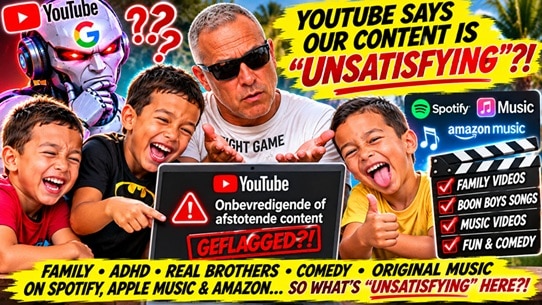
The timing of this changing accusation deserves investigation. Did my critical publications have anything to do with it, or did Google’s automated systems reach a different conclusion on their own?
Google could answer that question. Instead, I receive automated responses, contradictory explanations, and links to Help Centers. What makes this particularly ridiculous is that YouTube’s own team previously confirmed that it understood our creative process, content strategy, and channel’s brand. Did those reviewers subsequently forget everything they learned?
Our productions have improved considerably. We create original music, increasingly sophisticated animations, better storytelling, and more ambitious family entertainment. Yet our organic distribution continues to collapse. Other platforms apparently recognize the creative value that Google struggles to identify. Perhaps the Boon Boys should produce a documentary about a multinational technology company that cannot explain its own decisions. Unfortunately, Google might classify that documentary as disturbing content.
Although, judging by my experiences, it would certainly qualify as a comedy.
Google YouTube Bots Remove the Appeal Button: Justice Without an Appeal
YouTube proudly explains that creators can appeal decisions when they believe the platform has made a mistake. That sounds reasonable. Unfortunately, exercising that right becomes considerably more complicated when the appeal button disappears.
My dashboard explicitly stated that May 1, 2026, was the final date to submit an appeal.
However, the appeal mechanism disappeared before that deadline. What a magnificent administrative innovation! Google sets a deadline, removes the mechanism needed to meet it, and then informs the creator that the deadline has expired. Imagine an airline canceling your flight, closing the airport, and then refusing your refund because you failed to arrive at the departure gate. That is about how Google’s automated support system feels.
Creator Support also became inaccessible. My opportunities to communicate with an actual human being gradually disappeared, alongside my subscribers and organic distribution.
Google celebrates accessibility, inclusion, and equal opportunity. Perhaps accessibility does not include access to an appeal button. The situation becomes even more concerning when YouTube warns that an unsuccessful appeal could affect other channels under the same ownership. In other words, challenging a decision may potentially expose additional channels to consequences.
How reassuring for creators who have invested years of work and substantial amounts of money into their businesses. Google should provide transparent explanations, accessible appeal mechanisms, and meaningful human oversight when automated enforcement decisions affect creators. Instead, I find myself documenting screenshots, publishing articles, filing complaints, and trying to reach someone who can investigate the problem.
For eight years, I’ve been building a digital legacy for my children, and my latest occupation seems to be collecting evidence against the company hosting that legacy. Perhaps Google should introduce another slogan:
**You have the right to appeal. Unfortunately, the button exercising that right is currently unavailable.**
Pay for Advertising or Become Invisible: Google’s Impossible Rehabilitation Program
On November 20, 2026, my YouTube Studio dashboard displayed some extraordinary statistics.
The Boon Family channel had 98,685 subscribers, far exceeding the 1,000-subscriber threshold. However, YouTube recorded only 193 qualified watch hours, compared with the 4,000 required under that eligibility route.
The alternative route required ten million qualified Shorts views within 90 days. My dashboard displayed approximately 1,000. Now examine the organic distribution of my recent uploads. Numerous Shorts receive zero recent traffic from the Shorts feed. Long-form videos receive extremely limited impressions. Identical productions attract hundreds of thousands of viewers on competing platforms. Google expects me to generate millions of qualified views while its distribution systems barely expose my content to potential viewers.
How exactly does Google propose that I accomplish this extraordinary mathematical challenge? Should I purchase advertising again? Unfortunately, views and watch time generated through advertising campaigns do not count toward these monetization eligibility thresholds.
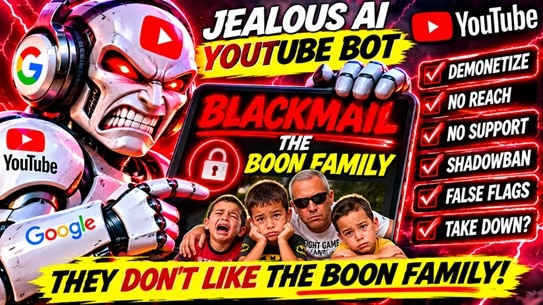
Brilliant!
Google YouTube bots have left me in an extraordinary situation. I have nearly 100,000 subscribers, yet my content receives the exposure one might expect from a newly established channel with virtually no audience. Meanwhile, YouTube Studio warns that my Google Ads account has been canceled. Google insists that advertising does not influence organic performance.
My experience raises serious questions about whether its automated systems consistently operate according to that principle. Imagine a casino confiscating your chips and informing you that you must win another million before you can leave.
Welcome to Google’s algorithmic rehabilitation program.
The company expects creators to meet performance requirements, but what happens when its own systems may prevent them from achieving them? Google has the technical resources to investigate this discrepancy. So far, all I have received is an increasingly impressive collection of contradictory messages.
Become invisible, generate millions of views, and then we might reconsider your application. **
Even the Boon Boys could not invent a comedy sketch this ridiculous.
Google YouTube Bots Exposed: Improve Your Content Until You Become Invisible
Three Thai-Dutch brothers enjoying holidays, visiting tropical islands, singing original songs, performing comedy sketches, and creating funny family memories? Somebody should immediately inform the hundreds of thousands of people enjoying identical videos on TikTok, Instagram, and Facebook that they have exceptionally poor taste. Apparently, only Google YouTube bots possess the intellectual capacity to recognize how repulsive the Boon Boys really are.
Ironically, YouTube and its influencers constantly encourage creators to embrace AI, improve every second of their videos, develop their niche, experiment with new formats, and increase audience retention.
So, I followed their advice.
I produced original Boon Boys songs, combined live-action footage with animations, and created funny, family-friendly music videos. These productions require considerable creativity, patience, editing, and countless hours of work.
Watch one of our original Boon Boys music videos here.
Our original music is also available through Apple Music, iTunes, and other music platforms. I created short promotional videos featuring our songs and animations to support these productions. Every upload revolves around the Boon Family. Unfortunately, following YouTube’s advice may have confused its own angry bots. A family holiday video? Fine. A funny Short featuring the same children? Suspicious. An original music video starring those same three boys? Emergency! Somebody call the algorithm police! Perhaps Google’s artificial intelligence suffers from an identity crisis whenever a creator demonstrates more than one creative ability.
YouTube encourages innovation, yet its automated systems may struggle to distinguish creative diversity from inconsistent content. What exactly does Google want? Better productions or eight years of identical videos? Of course, producing repetitive videos might earn me another accusation of mass-produced content.
**Improve your content and become invisible. Repeat your content and become inauthentic.**
Welcome to YouTube’s creative paradise.
Pay for Advertising: Did Google Sell Me the Wrong Audience?
I understand that switching between family vlogs, comedy Shorts, original music videos, and animated productions might confuse an algorithm. However, every production features the Boon Family, the Boon Boys, or their adventures. The descriptions clearly explain the content, and I organize everything into relevant playlists. Furthermore, I invested more than €35,000 to build this channel, including targeted advertising designed to attract people interested in our niche. We are not talking about randomly collecting subscribers from a vegetable market in Mongolia.
Google sells sophisticated advertising technology that supposedly identifies relevant audiences according to their interests, viewing habits, and preferences.
With approximately 100,000 subscribers, I would consider a five-percent response to a new upload a reasonable expectation worth investigating. That would represent 5,000 viewers, though no platform guarantees that conversion rate. Instead, numerous uploads struggle to attract even a few hundred viewers. Where exactly did Google’s sophisticated targeting technology find my audience?
At a retirement home for inactive robots?
Either Google acquired subscribers who have virtually no interest in our productions, those subscribers rarely receive our content, or something else prevents them from engaging. All three possibilities deserve investigation. The situation becomes even more absurd when identical videos outperform YouTube by tens of thousands of percent on competing platforms.
Did TikTok accidentally discover the audience that I paid Google to find?
Google YouTube bots apparently possess an extraordinary talent for turning financial investment, creative improvement, and audience growth into digital invisibility.
After eight years of work, I would appreciate an explanation of what my advertising expenditure actually purchased.
**I paid to build an audience, not to become the proud owner of a digital ghost town.**
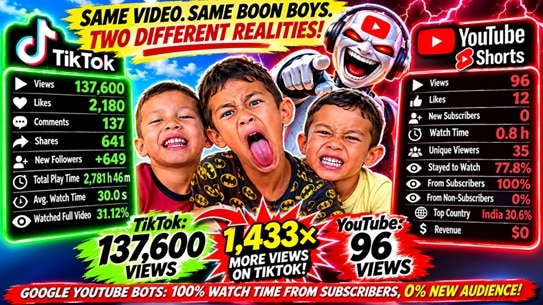
TikTok vs. YouTube: Has the Algorithm Gone Rogue?
Two years of this circus, and it keeps getting worse. Followers increase everywhere except YouTube, where subscribers keep disappearing. Did I pay Google to recruit an army of bots?
Facebook, Instagram, and TikTok love the content. YouTube buries it. Deliberate targeting, a sick algorithm, or an AI rebellion?
Perhaps Google should stop updating its bots and start medicating them.
Imagine how many more entertaining Boon Family videos I could have produced if I had invested all the time and energy spent writing blogs, collecting screenshots, submitting complaints, and fighting Google YouTube bots into actual creative productions. Instead of producing comedy, music videos, and unforgettable family adventures, I have become an unpaid investigative journalist specializing in Google’s algorithmic madness.
Google encourages creators to spend more time creating quality content. Ironically, its own systems have turned a passionate content creator into a full-time complaints department.
Perhaps Google should monetize my complaints. At least that content never runs out of material.
(C) Bas Boon
YouTube Not Recommending Any Video: Shadowban and Demonetization!
https://basboon.com/youtube-not-recommending-any-video-shadowban-and-demonetization/
“Google spent billions developing artificial intelligence. Yet it took a human to approve my channel, a bot to punish it six hours later, and two years to discover that the only thing artificial about this intelligence is the intelligence itself.”
— Bas Boon